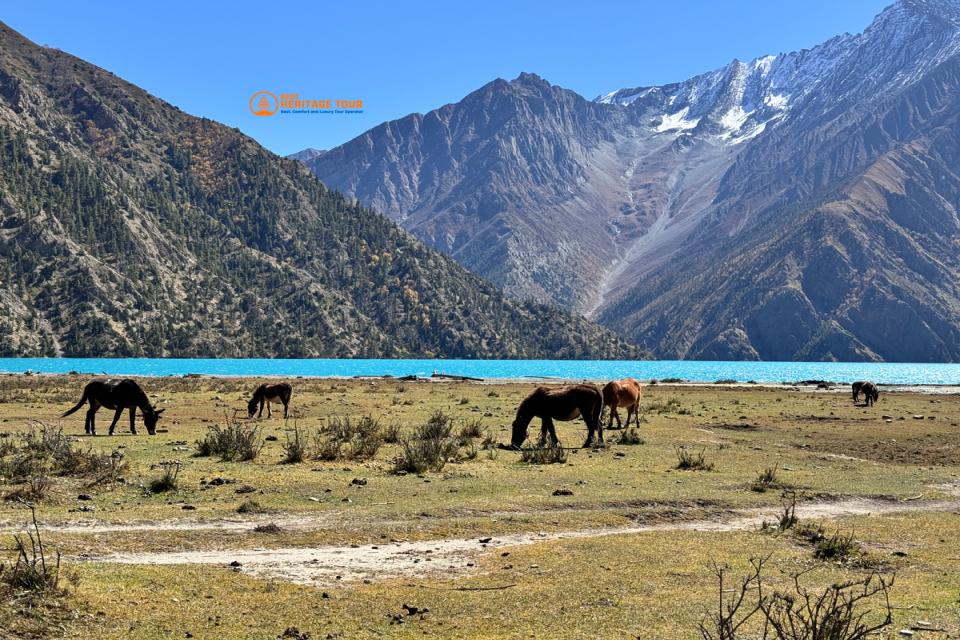
If you have ever gazed at photos of the pristine, deep-blue waters of Shey Phoksundo Lake, or dreamed of walking the windswept, trans-Himalayan landscapes made famous by Peter Matthiessen’s The Snow Leopard, Upper Dolpo has undoubtedly captured your imagination. It is a region where time stands still, Tibetan Buddhist culture thrives in its purest form, and the rugged beauty of the Himalayas remains entirely untouched by mass tourism.
However, as you begin researching this bucket-list journey, one question inevitably surfaces: How expensive is the Upper Dolpo Trek?
When compared to classic Nepal routes like the Everest Base Camp or the Annapurna Circuit, the financial investment for Upper Dolpo is significantly higher. A standard 20 to 27-day expedition generally ranges anywhere from $3,500 to over $6,000 USD per person.
At Best Heritage Tour, we believe in complete transparency. We understand that discerning travelers need to know exactly where their investment goes. In this definitive guide, we will break down every core reason for being Upper Dolpo Trek expensive, outline what to expect for the Upper Dolpo Trek in 2027, and explain why this untamed wilderness is worth every single dollar.
1. The Steep Cost of Government Restricted Area Permits
The foremost factor behind the premium pricing of this trek is the strict regulatory framework enforced by the Department of Immigration in Nepal to preserve Dolpo's fragile ecosystem and ancient border culture.
Unlike open trekking regions, Upper Dolpo is a strictly regulated border zone adjacent to Tibet. To enter, the government requires specialized permits that cannot be obtained independently; they must be processed through a registered local trekking agency like ours.
The Permit Fee Breakdown:
-
Upper Dolpo Restricted Area Permit (RAP): This is the heaviest expense. It costs $500 USD per person for the first 10 days, and an additional $50 USD per person per day for every day spent inside the restricted zone thereafter.
-
Lower Dolpo Restricted Area Permit: Because the entry routes wind through Lower Dolpo, you also require this permit, which costs $20 USD per person per week.
-
Shey Phoksundo National Park Entry Fee: To traverse Nepal’s largest national park, there is an environmental conservation fee of NPR 3,000 (approx. $23 USD).
-
TIMS Card (Optional): The Trekkers’ Information Management System card adds another NPR 2,000 (approx. $15 USD).
By the time you step foot on the trail, nearly $700 to $900 USD per person has already been allocated strictly to government permits and conservation fees.
2. The Logistics of a True Wilderness Expedition (The Tented Camp Factor)
When you trek in Everest or Annapurna, you are moving from one well-established village to another, staying in local teahouses, and ordering from extensive menus. Upper Dolpo is an entirely different world.
Upper Dolpo is one of the last remaining pure camping treks in Nepal. There are virtually no commercial teahouses or tourist lodges beyond the very early stages of the trail.
Kathmandu -- Flight 1 -- Nepalgunj -- Flight 2 -- Juphal -- Trek Starts -- Total Wilderness / Camping
To operate a safe and comfortable trip in this isolated wilderness, we must deploy a fully self-sustained expedition. This means our team must provide and transport:
-
High-altitude, weather-resistant sleeping tents and warm insulation mats.
-
Kitchen tents, dining tents, tables, chairs, and toilet tents.
-
All cooking utensils, stoves, and fuel (kerosene or gas gas cylinders) required for nearly three weeks.
-
Fresh, nutritious ingredients to fuel your body through demanding high-altitude passes.
Setting up a mobile village every evening and tearing it down every morning requires immense logistical coordination, which naturally drives up the operational costs.
3. High Crew-to-Client Ratios: Fair Wages, Food, and Insurance
Because a tented expedition is incredibly resource-heavy, it cannot be run with just a single guide and a couple of porters. For a small group of trekkers, we must employ an entire support crew. Your expedition team typically includes:
-
A Licensed, Professional Trekking Guide: Possessing specialized knowledge of Dolpo’s unique geography, dialects, and high-altitude safety protocols.
-
A Professional Mountain Cook & Kitchen Crew: Trained specifically in culinary hygiene to prepare hot, three-course meals daily at 4,000+ meters.
-
Mules, Yaks, and Porters: To transport hundreds of kilograms of camping gear, fuel, luggage, and food supplies across challenging terrains.
Our Commitment to Ethical Trekking: At Best Heritage Tour, we ensure that every single member of our crew receives fair industry-standard daily wages, comprehensive medical insurance, and proper high-altitude gear. Because the cost of food and living supplies is exceptionally high in remote Dolpo, providing for our crew's welfare on a 25-day trek represents a substantial and worthwhile investment.
4. Complex and Weather-Dependent Domestic Flights
Geographical isolation is part of Upper Dolpo’s mystical charm, but it also means getting there is an adventure in itself. You cannot simply hop on a tourist bus from Kathmandu.
Reaching the trailhead at Juphal requires a multi-stage aviation journey:
-
Flight 1 (Kathmandu to Nepalgunj): A commercial domestic flight from the capital to the lowlands of southern Nepal.
-
Flight 2 (Nepalgunj to Juphal, Dolpa): A thrilling mountain flight on a small twin-otter aircraft that lands on a remote, carved-out airstrip in the mountains.
Why Flight Logistics Escalate the Budget:
-
Four Flights Total: Round-trip travel means booking four separate domestic flights per trekker.
-
Cargo & Weight Limits: Small mountain planes have strict weight allowances. Transporting heavy camping equipment and food supplies requires paying substantial excess baggage fees or booking dedicated cargo space.
-
Crew Transportation: We must also fly our specialized guides and cooks from Kathmandu/Nepalgunj into Juphal, multiplying the total airfare costs.
5. The "Remote Surcharge" of the Trans-Himalayan Rain Shadow
Upper Dolpo sits behind the towering Dhaulagiri massif in a high-altitude rain shadow. There are no motorable roads connecting Upper Dolpo to the rest of Nepal.
Consequently, every single item that isn't grown locally - from fresh vegetables, rice, and coffee to medicine and matches - must either be flown into Juphal or carried over grueling mountain passes via mule trains from lower districts.
|
Item / Resource |
Sourcing & Transport Method |
Impact on Trek Cost |
|---|---|---|
|
Basic Foodstuffs |
Carried by mules/yaks over weeks or flown via cargo |
Prices can be 3x to 5x higher than Kathmandu prices. |
|
Kerosene / Cooking Fuel |
Manually transported in heavy containers |
Vital for camping; requires dedicated pack animals. |
|
Emergency Medical Supplies |
Stocked and carried from Kathmandu |
Non-negotiable for safety; adds to foundational package cost. |
When a simple box of eggs or a liter of fuel requires days of manual transport to reach a campsite at 4,500 meters, the operational expenses reflect that reality.
Planning Ahead: The Upper Dolpo Circuit Trek in 2027
As we look ahead to the Upper Dolpo Trek in 2027, several factors are shifting the landscape of Himalayan travel.
The Government of Nepal and local municipalities are continually discussing infrastructural upgrades in Western Nepal. While slow-moving road construction is changing the face of lower regions, Upper Dolpo remains passionately protected by both local communities and global conservationists to retain its pristine wilderness status.
For 2027, permit regulations and minimum group size rules (a strict requirement of at least two trekkers per group accompanied by a licensed guide) remain firmly in place. Fuel costs and domestic aviation tariffs across Nepal have experienced steady adjustments, meaning that booking your trek early through an established operator is more crucial than ever to lock in competitive pricing and secure highly coveted domestic flight seats during the prime Spring and Autumn seasons.
Is the Upper Dolpo Trek Worth the Premium Price?
When looking at the raw figures, it is completely natural to wonder if the journey justifies the expense. However, every traveler we have ever guided through Dolpo returns with the same conclusion: It is priceless.
Your Investment
Restricted Area Protection ➔ Zero Crowds (Only ~500 travelers/year)
Complex Flight & Mule Logistics ➔ Pristine, Untouched Nature
Full Camping Crew ➔ Complete Self-Sufficiency & Unmatched Safety
By choosing Upper Dolpo, you aren't paying for luxury hotels; you are paying for exclusivity, raw adventure, and unparalleled cultural preservation. You will walk trails where you won't see another group of tourists for days. You will stand in Shey Gompa, an 800-year-old monastery at the base of the sacred Crystal Mountain. You will witness a way of life that has remained unchanged for centuries.
Conclusion
The reason for being Upper Dolpo Trek expensive boils down to its magnificent isolation, strict environmental protections, complex aviation demands, and the comprehensive logistics required to run a safe, fully catered expedition in the wild. It is not just a holiday; it is an elite, fully managed mountain expedition into one of the most mysterious corners of the earth.
At Best Heritage Tour, we pride ourselves on curating seamless, deeply authentic, and safety-first journeys into Dolpo. We handle the bureaucratic maze of restricted permits, secure your volatile domestic flights, and provide an expert local crew so that your only job is to absorb the breathtaking majesty of the Himalayas.
Are you ready to plan your ultimate Himalayan odyssey for the upcoming seasons or looking forward to booking the Upper Dolpo Trek in 2027? Let our team design a customized, transparently priced itinerary tailored specifically to your goals.
Plan Your Journey with Best Heritage Tour
Phone / WhatsApp / Viber: +977-9851149197 / +977-9810043046
Email: info@bestheritagetour.com / bestheritagetour@gmail.com
Website: www.bestheritagetour.com
Office: Thamel Marg, Kathmandu, Nepal
Author: Best Heritage Tour
Date: 17th May, 2026