Boudhanath Stupa is one of Kathmandu's most significant Buddhist pilgrimage destinations, attracting religious devotees, cultural travelers, photographers, and visitors exploring Nepal's heritage. Beyond its iconic white dome and golden spire, the surrounding area offers opportunities to discover Buddhist symbolism, traditional worship, sacred images, and the cultural life of the local community.
For travelers searching for the Places to Explore Inside the Boudhanath Stupa Area, understanding the individual structures and shrines can make a visit more meaningful. The monument is not simply a landmark to photograph; its architecture represents Buddhist ideas about the universe and the spiritual path toward enlightenment. Pilgrims express their devotion through circumambulation, prayer, and meditation, while visitors can observe these traditions respectfully.
At Best Heritage Tour, we encourage travelers to explore Boudhanath with an appreciation for its religious importance and living heritage. This guide introduces the main stupa structures, guardian idols, and other nearby religious sites, helping visitors understand what they can see and how each place contributes to the area's cultural identity.
I. Main Stupa Structures
The central monument is the heart of the Boudhanath heritage area. Its different architectural components have religious meanings that are closely connected with Buddhist philosophy. Exploring these structures allows visitors to appreciate the monument beyond its impressive appearance.
1. The Boudhanath Stupa (Khasuti)
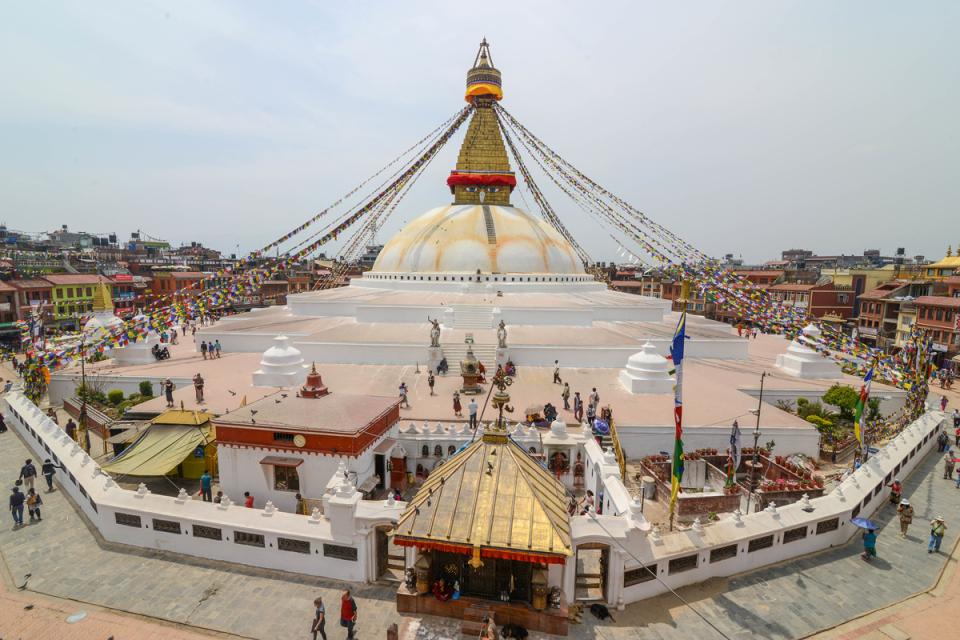
The Boudhanath Stupa, also known as Bouddhanath or Boudha Stupa, is the principal attraction in the area. Its traditional Newari name is Khasti Chaitya, and it is recognized as part of the Kathmandu Valley UNESCO World Heritage property. The stupa is a major center of Tibetan Buddhist worship and pilgrimage in Nepal.
The monument's design is often understood as a three-dimensional mandala, a sacred representation of the Buddhist universe. Its large white dome rises above a series of stepped platforms, creating a distinctive structure visible from different parts of the surrounding neighborhood.
For Buddhist devotees, walking around the stupa is an important religious practice. This ritual, known as kora or circumambulation, is generally performed clockwise. Visitors can observe pilgrims turning prayer wheels, reciting mantras, offering prayers, and walking quietly around the monument.
The stupa is also associated with traditional stories about its origin. One well-known legend tells of a devoted woman named Jyajima who wished to build a Buddhist monument and received permission from a king. Such stories are an important part of local religious tradition, although accounts of the stupa's early history vary.
What to explore here:
-
Observe the large white dome and its distinctive architectural proportions.
-
Walk around the stupa clockwise with local pilgrims.
-
Notice the prayer wheels arranged around the monument.
-
Watch the daily worship practices of Buddhist devotees.
-
Explore the surrounding courtyards and traditional neighborhood.
The central stupa is the starting point for understanding the other structures and sacred images found throughout the area.
2. Harmika
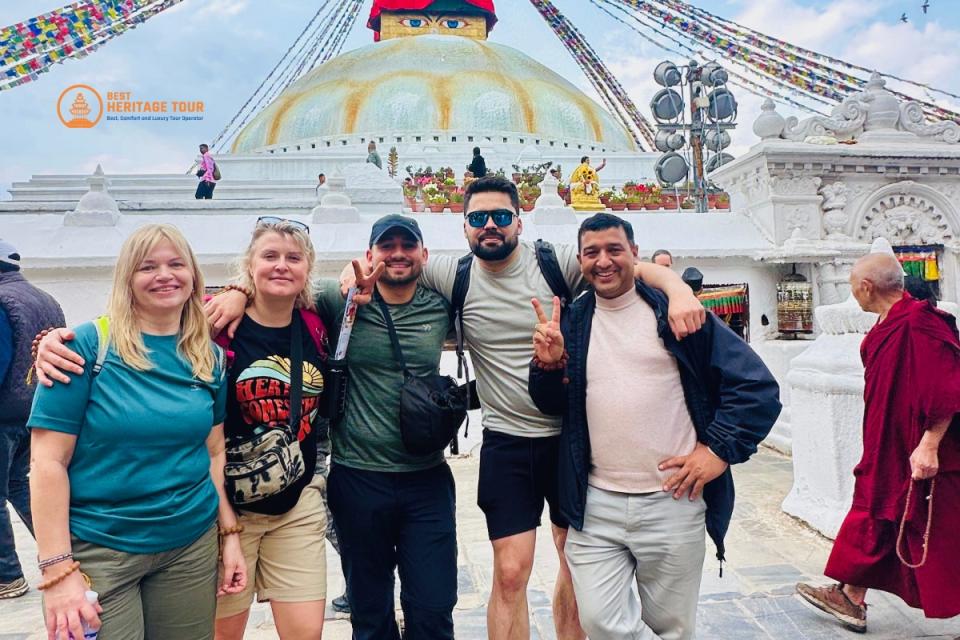
The Harmika is the square structure positioned above the white dome of Boudhanath Stupa. It is one of the monument's most recognizable architectural features because it carries the famous painted eyes of the Buddha.
The Buddha's eyes face the four cardinal directions, symbolizing awareness and wisdom extending throughout the world. Between the eyes is a symbol resembling a question mark, commonly interpreted as the Nepali numeral one. It represents unity and is associated with the idea of a single path toward spiritual realization.
The Harmika is more than an architectural decoration. It forms an important transition between the dome and the upper spire, connecting the lower structure with the monument's higher symbolic elements.
What to notice: Look carefully at the painted eyes, the central symbol, and the square shape of the structure. These details are easier to appreciate from the surrounding courtyard, where visitors can observe the monument from different angles.
3. The 13-Step Spire
Above the Harmika rises the golden, tapering spire, which is commonly described as having thirteen levels. These levels represent stages on the Buddhist path toward enlightenment.
The spire's upward movement creates a visual impression of spiritual progress. Each diminishing level draws the viewer's attention toward the summit, reflecting the Buddhist aspiration to move beyond ordinary limitations and attain a higher state of realization.
The golden appearance of the spire contrasts beautifully with the white dome below it. Colorful prayer flags are often attached around the upper structure, adding movement and color to the monument.
What to explore here:
-
Observe the thirteen diminishing levels of the spire.
-
Notice the golden surface and its relationship with the white dome.
-
Look at the prayer flags extending from the upper structure.
-
Consider the spiritual meaning associated with the upward design.
Visitors cannot ordinarily approach or climb the spire itself, but its details can be viewed from the ground and surrounding terraces.
4. Gold Pinnacle
The golden pinnacle, or finial, marks the uppermost part of the stupa. It completes the monument's vertical structure and draws the eye toward the sky.
In traditional Buddhist interpretations of stupa architecture, the uppermost elements are associated with the culmination of the spiritual journey. The pinnacle is also connected with the symbolism of space or ether in explanations of the monument's five-element design.
Although it is a relatively small feature compared with the dome, the pinnacle gives the stupa its complete and balanced appearance.
For photographers, the golden summit is particularly striking when viewed against a clear sky. Visitors can also observe how the sunlight changes the appearance of the gold throughout the day.
II. Guardian Idols and Shrines
Boudhanath is surrounded by sacred imagery that reflects different aspects of Buddhist belief. These figures are not simply decorative sculptures; they represent spiritual qualities, protective forces, and devotional traditions.
5. Idol of Bajrapani
Bajrapani, also written as Vajrapani, is an important figure in Mahayana and Vajrayana Buddhist traditions. His name is associated with the vajra, a ritual symbol representing spiritual power and indestructible wisdom.
In Buddhist iconography, Vajrapani is commonly represented as a protector of the Buddha and Buddhist teachings. His image may appear in a powerful or dynamic form, distinguishing him from the peaceful appearance of many Buddha figures.
The presence of Vajrapani imagery in Buddhist sacred spaces reflects the importance of protection, strength, and the preservation of spiritual teachings.
When exploring the Boudhanath area, visitors interested in Buddhist art can look for representations of Vajrapani among the sacred images and shrines. The exact placement and visibility of individual idols may vary depending on access and ongoing religious activities.
Why it matters: Understanding Vajrapani helps visitors recognize that Buddhist sacred art includes different figures with distinct symbolic roles, rather than representing every image as the Buddha himself.
6. Idol of Khadgapani
Khadgapani is another Buddhist figure associated with sacred imagery and protective symbolism. The name is connected with the khadga, or sword, which can represent the cutting away of ignorance and spiritual obstacles.
In Buddhist iconography, the sword is often understood as a symbol of wisdom that removes confusion and helps practitioners recognize truth.
Khadgapani's representation provides an opportunity to learn about the different symbolic objects used in Buddhist art. These objects communicate religious ideas through visual forms, allowing devotees and visitors to understand spiritual qualities without relying only on written explanations.
When viewing sacred images around Boudhanath, visitors should take time to notice the figures' gestures, clothing, and objects. These details can reveal important aspects of their religious identity.
7. The 108 Stone Idols of Various Deities
One of the notable features associated with Boudhanath Stupa is the presence of numerous sacred images arranged around its lower structure. The number 108 holds special significance in Buddhist religious traditions.
The stupa's surrounding niches contain images of Buddhist deities and enlightened figures. Some descriptions identify the images as representations of Amitabha Buddha, while other accounts describe a wider range of Buddhist figures.
The repeated arrangement of these images contributes to the monument's mandala-like character. Each niche forms part of a larger sacred composition, connecting individual representations with the overall design of the stupa.
For visitors, these stone idols offer an opportunity to appreciate traditional craftsmanship and religious symbolism. Their placement around the monument also creates a meaningful connection between the architecture and the devotional practices performed by pilgrims.
What to observe:
-
The arrangement of images around the monument.
-
Differences in posture and symbolic gestures.
-
The relationship between the sacred figures and the surrounding prayer wheels.
-
The way repeated images contribute to the stupa's overall design.
Visitors should avoid touching or climbing on the sculptures, as these are sacred and heritage features.
Tips for Exploring the Boudhanath Stupa Area
A visit to Boudhanath can be both a cultural sightseeing experience and an opportunity to observe an active place of worship. A few simple practices help visitors explore respectfully.
-
Walk clockwise: Follow the direction used by Buddhist pilgrims when circumambulating the stupa.
-
Dress respectfully: Choose clothing that covers the shoulders and is appropriate for a religious setting.
-
Ask before photographing people: Be considerate when taking pictures of monks, worshippers, or religious ceremonies.
-
Respect sacred objects: Avoid touching idols, prayer offerings, or restricted areas.
-
Observe quietly: Keep noise low near shrines and during prayer activities.
-
Allow time to explore: The main stupa, surrounding lanes, and nearby religious sites deserve more than a brief photo stop.
-
Check access locally: Some structures may have restricted access during ceremonies, restoration work, or religious events.
Conclusion
The Boudhanath Stupa area offers much more than a single landmark. From the white dome and symbolic Harmika to the thirteen-step spire, golden pinnacle, sacred images, and nearby religious sites, each place contributes to the area's spiritual and cultural identity.
For travelers searching for Places to Explore Inside the Boudhanath Stupa Area or Hidden Temples Inside the Boudhanath Stupa Complex, understanding the difference between the main monument, its surrounding shrines, and separate destinations such as Sankhu can help create a more meaningful itinerary.
At Best Heritage Tour, we help travelers discover Nepal's cultural landmarks through thoughtfully organized heritage experiences. Whether you are interested in Buddhist traditions, historic architecture, religious pilgrimage, or cultural photography, exploring Boudhanath with local context can make your visit more informative and memorable.
For more information about visiting Boudhanath Stupa and arranging a cultural tour in Kathmandu, contact Best Heritage Tour.
Phone / WhatsApp / Viber: +977-9851149197 / +977-9810043046
Email: info@bestheritagetour.com / bestheritagetour@gmail.com
Website: www.bestheritagetour.com
Office: Thamel Marg, Kathmandu, Nepal
Author: Best Heritage Tour
Date: 29th September, 2026