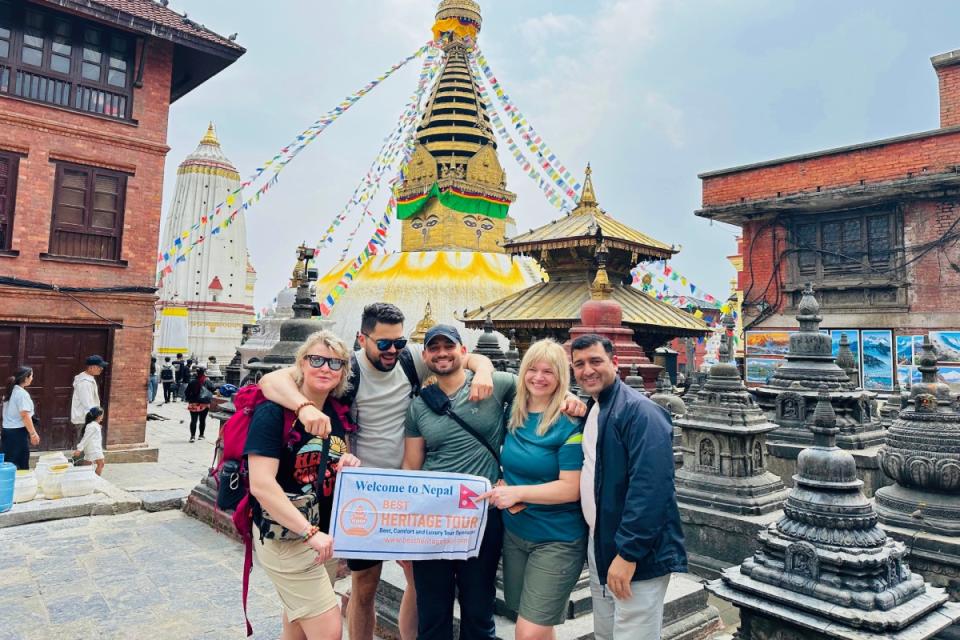
Swayambhunath Stupa is one of the most important religious and cultural landmarks in Kathmandu, Nepal. Located on a hill west of the city, this historic Buddhist pilgrimage site is known for its ancient white dome, golden spire, colorful prayer flags, sacred temples, and panoramic views of the Kathmandu Valley. Beyond the famous main stupa, the surrounding complex contains numerous shrines, monasteries, statues, and monuments that reveal the area's rich spiritual and artistic traditions.
For travelers, trekkers, and religious visitors, exploring the entire Swayambhunath Stupa area offers a deeper understanding of Nepal's living heritage. The complex brings together Buddhist and Hindu traditions, with worshippers visiting its sacred spaces for prayer, meditation, festivals, and religious offerings.
At Best Heritage Tour, we encourage visitors to explore beyond the main viewpoint and take time to appreciate the smaller monuments and peaceful corners of this historic site. With years of experience organizing cultural tours in Nepal, we help travelers understand the stories, symbolism, and traditions connected with the places they visit.
This guide introduces the major places to explore inside the Swayambhunath Stupa area, including its primary temples, monasteries, museums, statues, and access points.
I. Main Stupa and Primary Temples
The main stupa and its surrounding temples form the spiritual heart of the Swayambhunath complex. Each structure has its own religious meaning, architectural character, and place in local traditions.
1. Swayambhunath Stupa (Swoyambhunath Mahachaitya)
The main Swayambhunath Stupa, also known as Swoyambhunath Mahachaitya, is the central attraction of the complex. Its large white dome, gilded spire, Buddha eyes, and prayer flags make it one of Kathmandu's most recognizable religious monuments.
According to Buddhist tradition, the Kathmandu Valley was once covered by a lake. A lotus flower bearing divine light appeared in the lake, and the bodhisattva Manjushree later drained the water to make the valley habitable. The stupa is closely connected with this sacred origin story.
The monument is an important center of Buddhist worship, particularly within Vajrayana traditions. Visitors can observe devotees walking clockwise around the stupa, turning prayer wheels, offering prayers, and lighting butter lamps.
The elevated platform surrounding the stupa also provides views across Kathmandu Valley.
2. Anantapur Temple
Anantapur is one of the two distinctive white, shikhara-style temples standing near the main stupa. It was built during the reign of King Pratap Malla in the seventeenth century.
Its tall, tapering structure and traditional design create a striking contrast with the rounded white dome of the main chaitya. The temple is an important part of the historic architectural landscape around Swayambhunath.
Visitors can appreciate its exterior details while exploring the nearby monuments.
3. Pratappur Temple
Pratappur is the second of the two shikhara-style temples associated with King Pratap Malla. Located near Anantapur, it contributes to the distinctive appearance of the eastern side of the stupa.
The temple reflects the traditional architectural craftsmanship of the Kathmandu Valley. Its placement beside the main stupa also illustrates how different forms of religious architecture developed together within the same sacred complex.
Both Anantapur and Pratappur are worth viewing as part of a complete heritage walk.
4. Harati Mata Temple
Harati Mata Temple, also called Ajima Temple, is dedicated to Harati, a goddess worshipped as the protector of children. It is among the most important Hindu-Buddhist shrines within the Swayambhunath complex.
According to a popular Buddhist story, Harati once took children from other families to feed her own large family. After Buddha hid her youngest child, she experienced the suffering of parents whose children had been taken. She later became a protector of children.
The temple is particularly meaningful to parents and families who visit to pray for their children's health and well-being. Its traditional pagoda-style architecture and religious atmosphere make it an important stop during the visit.
5. Shantipur
Shantipur is a sacred shrine within the Swayambhunath area, associated with religious traditions and stories of spiritual power. It is also identified in heritage documentation as one of the important monuments of the Swayambhu zone.
The shrine is connected with local legends involving tantric practices and spiritual protection. Visitors interested in the deeper religious traditions of Kathmandu can learn about its significance from a knowledgeable local guide.
As a sacred place, it should be approached respectfully, and visitors should follow any restrictions on entry or photography.
6. Agnipur Temple
Agnipur is a small religious monument associated with Agni, the Hindu deity of fire. It forms part of the group of symbolic shrines found around the main stupa.
The name connects the monument with fire, one of the traditional elements represented in religious symbolism. Although it is smaller than the principal temples, Agnipur contributes to the spiritual landscape of the complex.
Visitors exploring the surrounding shrines can appreciate how Buddhist and Hindu religious elements exist side by side in this historic pilgrimage area.
7. Basupur Temple
Basupur is a small shrine associated with Basundhara, a goddess connected with prosperity and abundance. It is one of the religious monuments located near the main stupa.
The shrine reflects the presence of Hindu deities within the wider Buddhist pilgrimage site. Its significance is connected with traditional beliefs about prosperity, well-being, and blessings.
For visitors, Basupur offers an opportunity to notice the smaller sacred structures that are often overlooked when attention remains focused only on the main stupa.
8. Saraswati Temple
Saraswati is worshipped as the Hindu goddess of knowledge, learning, music, and wisdom. A shrine associated with Saraswati is located in the wider Swayambhunath area, where she is also connected with Manjushree.
Students and families traditionally visit Saraswati shrines to pray for learning and educational success. The site becomes especially meaningful during Basanta Panchami, a festival associated with the goddess.
Visitors can learn about the shared religious identity of Manjushree and Saraswati and the importance of knowledge in both Buddhist and Hindu traditions.
9. Maha Manjushree Shrine
Maha Manjushree is associated with the Buddhist bodhisattva Manjushree, who represents wisdom. According to the traditional origin story of Kathmandu Valley, Manjushree drained the ancient lake and made the valley suitable for settlement.
The shrine is important to visitors interested in the spiritual history of Kathmandu. It also connects the religious landscape of Swayambhunath with the broader cultural story of the valley.
The shrine's association with Saraswati reflects the way Buddhist and Hindu traditions have influenced one another in Nepal.
II. Monasteries, Museums, and Lakes
The Swayambhunath area is not limited to temples and stupas. Its monasteries, museum, and quieter surroundings offer visitors opportunities to learn about Buddhist practices, traditional art, and the continuing religious life of the community.
10. Shree Karma Raj Maha Vihar
Shree Karma Raj Maha Vihar is a Tibetan Buddhist monastery located near the Swayambhunath stupa. It is associated with the Kagyupa tradition of Tibetan Buddhism.
The monastery contributes to the area's continuing religious life and provides an example of the Buddhist institutions found around the hill. Its presence also reflects the long-standing connections between Nepal and Tibetan Buddhist traditions.
Visitors should remember that monasteries are places of worship and practice. Quiet behavior and respect for religious activities are important when visiting.
11. Swayambhunath Museum
The Swayambhunath Museum is an informative stop for visitors interested in the history and artistic heritage of the complex.
Museums in the Swayambhunath area preserve and display religious and cultural objects, including traditional Buddhist and Hindu art. Such collections help visitors understand the craftsmanship and devotional practices associated with the monuments.
Opening arrangements and access may vary, so travelers should check locally before planning a museum visit.
12. Bishwo Shanti Lake
Bishwo Shanti Lake is a quieter feature associated with the wider Swayambhunath area. It can provide a peaceful break from the busy temple surroundings and the movement of visitors around the main stupa.
Visitors exploring this part of the complex can enjoy the calmer atmosphere while remaining mindful of the religious and cultural character of the site.
Because small features and access routes may not always be clearly marked, visitors can ask their guide or local staff for directions.
III. Access Points, Stairs, and Entry Areas
Swayambhunath can be approached through different access routes. The traditional eastern staircase is particularly well known, while road access makes the hilltop more accessible for visitors who prefer to avoid the full climb.
13. 365-Step Stairway
The eastern staircase is one of the most recognizable approaches to Swayambhunath. It is commonly referred to as the 365-step stairway, although the exact count may vary depending on how the steps are counted and the route used.
The climb passes through a wooded hillside and leads visitors toward the main religious complex. Along the way, travelers may encounter monkeys, small shrines, and views of the surrounding city.
The staircase can be steep, so visitors should take their time, wear comfortable footwear, and use the road entrance if the climb is unsuitable for them.
14. Bhagwanpau Entrance
Bhagwanpau is one of the access points associated with the Swayambhunath area. It provides an alternative approach for visitors exploring the wider religious and cultural surroundings.
Travelers using this entrance can ask local guides about the route to the main stupa and nearby monuments. The best approach may depend on traffic, mobility needs, and which parts of the complex they want to visit.
15. Buddhapark Entrance
Buddhapark is another approach associated with the Swayambhunath area. It can be useful for visitors arriving by road or exploring the surroundings beyond the main staircase.
As routes and access conditions may change, visitors should confirm the most convenient entrance with their driver or guide before beginning the visit.
IV. Statues, Idols, Relics, and Monuments
The statues and smaller monuments around Swayambhunath are an essential part of its religious identity. They represent Buddhist teachings, devotional practices, and the artistic traditions of the Kathmandu Valley.
16. Huge Gold-Plated Vajra (Thunderbolt)
The enormous gold-plated vajra, also known as a dorje, is one of the most recognizable monuments near the main stupa.
In Vajrayana Buddhism, the vajra symbolizes spiritual power, firmness, and the indestructible nature of enlightenment. Its prominent position near the stupa makes it an important religious and visual feature of the complex.
Visitors often stop here to observe the craftsmanship and take photographs from permitted areas.
17. Single-Stone Dipankar Buddha Idol
Dipankar Buddha is a figure associated with Buddhist traditions and stories of earlier Buddhas. Images of Dipankar are also connected with religious practices and devotional offerings in Nepal.
The stone idol is one of the features visitors may encounter while exploring the statues and shrines around Swayambhunath. Its significance is best understood as part of the wider Buddhist tradition of honoring enlightened beings and their teachings.
18. Buddha Janma Murti (Nativity Statue)
The Buddha Janma Murti represents the birth of Siddhartha Gautama, who later became known as Gautama Buddha.
Nativity images are important in Buddhist art because they commemorate the beginning of the life of the historical Buddha. Visitors can use the statue as an opportunity to learn about the early life and teachings associated with Buddhism.
19. Pancha Buddha Idols
The Pancha Buddha idols represent the Five Wisdom Buddhas, important figures in Vajrayana Buddhist symbolism. These Buddhas are associated with different aspects of wisdom and spiritual transformation.
The five Buddhas are commonly identified as Vairocana, Akshobhya, Ratnasambhava, Amitabha, and Amoghasiddhi. Their representations are significant features of the religious symbolism found around Swayambhunath.
20. Tara Idols
Tara is a revered female bodhisattva in Buddhist traditions, associated with compassion, protection, and the removal of obstacles.
Different forms of Tara appear in Buddhist art and worship. The Tara idols around Swayambhunath reflect the importance of female spiritual figures within the complex's religious landscape.
Visitors interested in Buddhist symbolism can ask their guide about the different forms and meanings represented by these images.
21. Three Akshobhya Buddha Statues
Akshobhya Buddha is one of the Five Wisdom Buddhas and is traditionally associated with the eastern direction and the transformation of anger into wisdom.
The Akshobhya images found around Swayambhunath form part of the complex's broader collection of Buddhist statues and devotional monuments. Visitors can observe their artistic features and learn about their symbolism while exploring the surrounding shrines.
Tips for Exploring the Swayambhunath Stupa Area
-
Wear comfortable shoes: The complex includes stairs, stone paths, and uneven walking surfaces.
-
Dress respectfully: Choose clothing that covers the shoulders and knees when visiting religious sites.
-
Walk clockwise around the stupa: Follow the direction used by local devotees when circumambulating.
-
Ask before photographing: Some shrines, ceremonies, and religious activities may have photography restrictions.
-
Respect worshippers: Keep your voice low and avoid interrupting prayers or rituals.
-
Watch for monkeys: Keep food and loose belongings secured, and avoid feeding or approaching them.
-
Allow enough time: A relaxed visit is more rewarding than rushing between monuments.
Conclusion
The Swayambhunath Stupa area offers much more than a famous hilltop viewpoint. Its main stupa, traditional temples, monasteries, sacred statues, and quieter corners provide a meaningful introduction to Nepal's religious and cultural heritage. Exploring these places helps travelers understand how Buddhist and Hindu traditions continue to shape everyday life in Kathmandu.
For visitors who want to discover the important monuments as well as the lesser-known places to explore inside the Swayambhunath Stupa area, a guided heritage visit can make the experience more informative and convenient.
Best Heritage Tour organizes cultural sightseeing experiences in Kathmandu, helping travelers explore the city's heritage with local insight and practical guidance.
Contact Best Heritage Tour to plan your Swayambhunath visit:
Phone / WhatsApp / Viber: +977-9851149197 / +977-9810043046
Email: info@bestheritagetour.com / bestheritagetour@gmail.com
Website: www.bestheritagetour.com
Office: Thamel Marg, Kathmandu, Nepal
Author: Best Heritage Tour
Date: 29th September, 2026