The Everest Base Camp (EBC) trek remains the ultimate high-altitude bucket-list adventure. However, following shifting government regulations across Nepal’s Himalayan corridors, independent travellers and solo trekkers often ask a critical question: Is it still legal, safe, and practical to trek to Everest Base Camp without a guide in 2027?
As a professional travel agency with years of operational experience in the Khumbu region, Best Heritage Tour provides this authoritative guide to clarify the current legal landscape, permit protocols, safety factors, and real-world logistics for independent trekkers.
The Legal Reality in 2027: National Directives vs. Khumbu Autonomy
Understanding the legalities of solo trekking in Nepal requires distinguishing between national policies and local governance in the Everest region.
The Short Answer: Yes, Solo Trekking to EBC is Allowed
Unlike regions such as Annapurna, Langtang, or Manaslu - where Nepal’s "No Guide, No Trek" regulation is strictly enforced - the Everest region remains an open exception.
In April 2023, the Nepal Tourism Board announced a nationwide rule requiring foreign trekkers to hire licensed guides. However, the local governing authority of the Everest trail - the Khumbu Pasang Lhamu Rural Municipality - publicly rejected this mandate within its jurisdiction. Utilizing local autonomy laws, the municipality issued an express notice confirming that independent and solo trekkers are welcome to trek in the Khumbu without a mandatory guide or agency.
The TIMS Card Exemption
Because of this local stance, the standard TIMS (Trekkers' Information Management System) card is NOT required for the Everest Base Camp trek. Trekkers do not need to register through the NTB digital portal in Kathmandu to start their trek in the Khumbu.
2027 Permit Requirements & Cost Breakdown for Independent Trekkers
While a guide is not legally required, obtaining the correct local permits is non-negotiable. Independent trekkers can purchase both required permits on-site during their journey.
|
Permit Type |
Issuing Location |
Standard Fee |
Purpose & Enforcement |
|---|---|---|---|
|
Khumbu Pasang Lhamu Entrance Permit |
Lukla or Monjo Checkpoint |
NPR 3,000 (~$23 USD) |
Replaced the TIMS card in Khumbu; directly funds local community infrastructure. |
|
Sagarmatha National Park Permit |
Monjo Gate or NTB Kathmandu |
NPR 3,000 (~$23 USD) + 13% VAT |
Covers trail maintenance, environmental conservation, and search protocols. |
|
TIMS Card |
Not Applicable |
$0 (Exempt) |
Not required for independent trekkers in the Khumbu region. |
Mandatory Travel Insurance: Regardless of whether you trek solo or with an agency, foreign trekkers must carry high-altitude medical insurance explicitly covering helicopter evacuation up to 6,000 meters. Authorities and rescue operators cross-verify coverage in emergencies.
Solo Trekking vs. Private Guided Trekking: Is Going Unguided Worth It?
Just because solo trekking is legal does not mean it is always practical. High altitude presents unique logistical and medical hurdles that independent travelers must manage on their own.
|
INDEPENDENT vs. GUIDED TREK |
|
|
UNGUIDED / SOLO TREK |
PRIVATE GUIDED (Best Heritage Tour) |
|
|
The Practical Challenges of Trekking EBC Unguided
-
Peak-Season Teahouse Lockouts: During peak trekking months (October-November and April-May), teahouses in high-altitude settlements like Tengboche, Dingboche, and Gorak Shep operate at 100% capacity. Guided groups hold pre-booked beds. Solo trekkers regularly face long waits, sleeping in cold dining halls, or being turned away.
-
Hidden Altitude Sickness (AMS) Risks: At elevations exceeding 4,000 meters (13,120 ft), hypobaric hypoxia impairs clear thinking. Mild Acute Mountain Sickness can rapidly advance to dangerous High Altitude Pulmonary Edema (HAPE) or Cerebral Edema (HACE). A solo trekker lacks an experienced secondary observer to spot cognitive decline or oxygen drops.
-
Emergency Evacuation Bottlenecks: In the event of injury or severe illness, coordinating a rescue helicopter requires immediate communication with insurance providers and charter operators in Kathmandu. Without local agency backing, securing a flight approval can take up to 24 hours.
Classic 14-Day Everest Base Camp Itinerary
To ensure safe physiological acclimatization, our expedition team structures the traditional EBC route with essential altitude-adaptation days.
Day 1: Fly to Lukla (2,860m) and Trek to Phakding (2,610m)
Distance: 8 km | Duration: 3-4 hrs.
Board an early flight from Kathmandu/Ramechhap to Lukla's Tenzing-Hillary Airport. Begin your descent along the Dudh Koshi River past traditional mani stones to reach Phakding.
Day 2: Trek from Phakding to Namche Bazaar (3,440m)
Distance: 11 km | Duration: 6-7 hrs.
Traverse suspension bridges - including the high Hillary Suspension Bridge - and check permits at the Monjo entry gate into Sagarmatha National Park. Finish with a steep climb up to Namche.
Day 3: Acclimatization Day in Namche Bazaar (3,440m)
Rest & Altitude Adaptation.
Hike to Everest View Hotel (3,880m) for panoramic views of Mount Everest, Lhotse, and Ama Dablam. Return to Namche to visit local bakeries and gear shops.
Day 4: Trek from Namche Bazaar to Tengboche (3,860m)
Distance: 10 km | Duration: 5-6 hrs.
Follow a high contour trail above the Imja Khola, descend to Phunki Tenga, and climb through rhododendron forests to famous Tengboche Monastery.
Day 5: Trek from Tengboche to Dingboche (4,410m)
Distance: 9 km | Duration: 5-6 hrs.
Cross the Imja River and ascend gradually through Pangboche, leaving the tree line behind for the alpine landscape of Dingboche.
Day 6: Acclimatization Day in Dingboche (4,410m)
Rest & High Ridge Hike.
Hike up Nagarjun Hill (5,100m) to view Makalu, Lhotse, and Island Peak. This step is critical before pushing past the 5,000-meter mark.
Day 7: Trek from Dingboche to Lobuche (4,940m)
Distance: 7 km | Duration: 5 hrs.
Ascend past the Thokla Pass memorials dedicated to fallen climbers. Follow the lateral moraine of the Khumbu Glacier up to Lobuche.
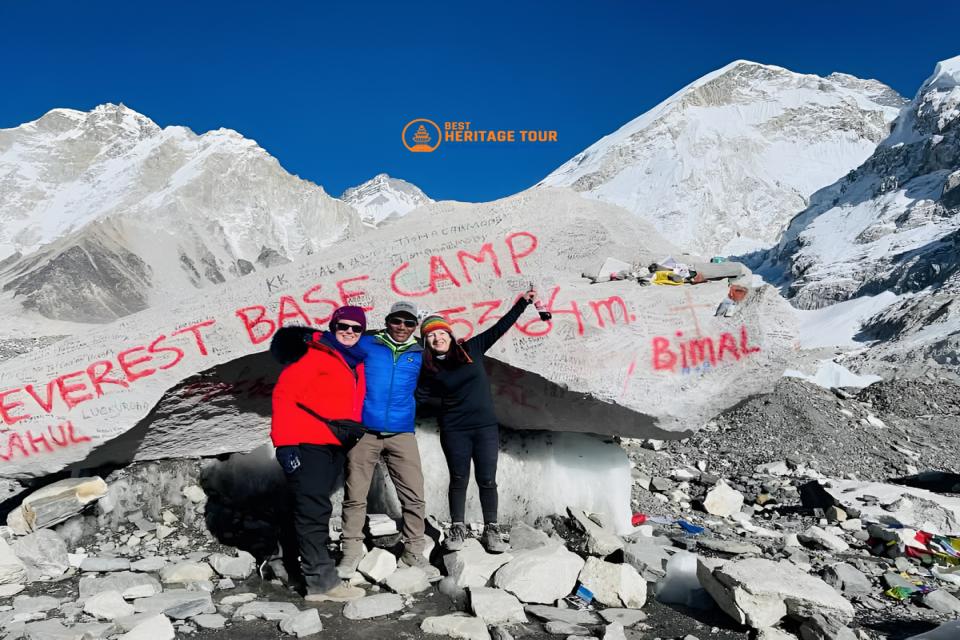
Day 8: Lobuche to Gorak Shep (5,164m) & Everest Base Camp (5,364m)
Distance: 13 km | Duration: 7-8 hrs.
Trek along the glacier to Gorak Shep, drop your main bag, and push forward to Everest Base Camp at 5,364 meters. Return to Gorak Shep for the night.
Day 9: Hike Kala Patthar (5,545m) and Descend to Pheriche (4,371m)
Distance: 12 km | Duration: 6-7 hrs.
Pre-dawn climb up Kala Patthar for sunrise views of Mount Everest's summit. Descend to Gorak Shep, pack, and trek down to Pheriche.
Day 10: Trek from Pheriche to Namche Bazaar (3,440m)
Distance: 14 km | Duration: 6-7 hrs.
Descend through Pangboche and Tengboche, returning to lower altitudes and warmer air in Namche Bazaar.
Day 11: Trek from Namche Bazaar to Lukla (2,860m)
Distance: 19 km | Duration: 7-8 hrs.
Complete your final day on the trail back along the Dudh Koshi Valley, exiting Sagarmatha National Park and celebrating in Lukla.
Day12: Fly from Lukla back to Kathmandu
End of Himalayan Trail Segment.
Board a morning flight from Lukla to Kathmandu. Transfer to your hotel for rest and celebration.
Essential Preparation Checklist for Independent & Guided Trekkers
Whether traveling solo or hiring a private guide through Best Heritage Tour, prepare around these four pillars:
1. High-Altitude Physical Conditioning
-
Cardiovascular Fitness: Engage in 3-4 sessions per week of stair climbing, incline treadmill walking, or trail running carrying a weighted pack (8-10 kg).
-
Leg Strength & Joint Stability: Target lower-body strength with lunges, step-downs, and squats to protect your knees during long descents.
2. Critical Gear Selection
-
Four-Season Sleeping Bag: Rated to -15°C to -20°C (5°F to -4°F); teahouse rooms are unheated at night.
-
Trekking Boots: Sturdy, waterproof boots broken in well before arrival.
-
Water Treatment: Dual purification system (UV Steripen + Chlorine Dioxide tablets). Single-use plastic bottles are restricted in Khumbu to reduce waste.
3. Medical & Safety Protocols
-
Ascent Management: Limit net elevation gain to 300-500 meters per day above 3,000 meters altitude.
-
Rest Days: Keep non-negotiable acclimatization stops at Namche Bazaar (3,440m) and Dingboche (4,410m).
-
Medical Kit: Carry Diamox (Acetazolamide), Ibuprofen, oral rehydration salts, and basic wound care supplies.
4. Contingency Planning
-
Buffer Days: Always leave 2 contingency days in Kathmandu at the end of your trip to accommodate Lukla weather flight delays.
-
Local Currency: Carry sufficient cash (Nepali Rupees) from Kathmandu. ATMs in Namche Bazaar are often out of cash or offline.
Conclusion
While solo trekking to Everest Base Camp is legally allowed under local Khumbu Pasang Lhamu Municipality guidelines, undertaking a high-altitude expedition independently requires managing significant logistical, medical, and environmental risks on your own.
Hiring a private guide or joining a tailored expedition with Best Heritage Tour gives you the best of both worlds: complete independence over your daily pace combined with decades of local Sherpa knowledge, guaranteed lodging, digital permit handling, and 24/7 safety monitoring.
Ready to Plan Your Everest Adventure?
Whether you need a full 12-day guided package, a private Sherpa guide, domestic flight bookings, or expert pre-trip advice, our team at Best Heritage Tour is ready to turn your Himalayan dream into a seamless reality.
Phone / WhatsApp / Viber: +977-9851149197 / +977-9810043046
Email: info@bestheritagetour.com / bestheritagetour@gmail.com
Website: www.bestheritagetour.com
Office: Thamel Marg, Kathmandu, Nepal
Frequently Asked Questions
Is solo trekking to Everest Base Camp legally allowed in 2027?
Yes. The local Khumbu Pasang Lhamu Rural Municipality permits independent and solo foreign trekkers in the Everest region. You do not legally require a registered guide or agency to enter Sagarmatha National Park.
Do I need a TIMS card for the Everest Base Camp trek?
No. Independent trekkers in the Khumbu region do NOT need a TIMS card. You only need to purchase the Khumbu Pasang Lhamu Entry Permit (at Lukla/Monjo) and the Sagarmatha National Park Permit (at Monjo).
Can I hire a private guide just for myself for EBC Trek?
Yes. Hiring a private guide through a Best Heritage Tour allows independent travelers to keep full control over their pacing and daily schedule while gaining local insight, pre-booked rooms, and medical monitoring.
Author: Best Heritage Tour
Date: 24th August, 2026