The iconic trail to Everest Base Camp (EBC) has long topped the bucket lists of global trekkers. Standing beneath Mount Everest at 5,364 m is an undeniable milestone. However, the modern reality of the Khumbu highway often means sharing narrow suspension bridges with literal traffic jams of trekkers, crowded teahouses, and a highly commercialized mountain environment. For those seeking raw Himalayan solitude, genuine cultural immersion, and untamed landscapes, the search for the best alternatives to the Everest Base Camp trek is more relevant than ever.
At Best Heritage Tour, our decades of local guiding experience across Nepal have taught us that the finest Himalayan magic often lies just off the beaten track. If your dream involves waking up to a silent, white wall of 7,000 and 8,000-meter peaks without a hundred selfie sticks blocking your view, you are in the right place.
Below, we break down 5 uncrowded alternatives to the Everest Base Camp trek that promise pristine wilderness, profound cultural depth, and unmatched Himalayan vistas.
The 5 Best Alternatives to EBC At a Glance
Before diving into the detailed trail profiles, let us look at how these hidden gems compare in duration, peak altitude, and style.
|
Trek |
Max Altitude |
Duration |
Primary Highlights |
Accommodation Style |
|---|---|---|---|---|
|
4,660 m (Khayer Lake) |
6-8 Days |
360° views of Dhaulagiri & Annapurna, Sacred Lakes |
Community Lodges & Teahouses |
|
|
4,065 m (Pikey Summit) |
5-7 Days |
Sir Edmund Hillary’s favorite view of Everest, Sherpa Culture |
Authentic local Teahouses |
|
|
5,309 m (Kang La Pass) |
9-12 Days |
Lost Tibetan-Buddhist enclaves, deep gorges, raw wilderness |
Basic Teahouses / Homestays |
|
|
4,200 m (Kalidhunga Lake) |
11-14 Days |
Untamed Far-West frontier, Doteli culture, total solitude |
Basic Homestays |
|
|
5,121m (Pass Summit) |
10-12 Days |
High-altitude pass, Tilicho Lake, wild wilderness traverse |
Teahouses & Camping |
1. The Khopra Danda Trek: The Ultimate Ridge-line Panorama
If you want the sweeping mountain theater of the Annapurna region without the crushing crowds of Poon Hill or Annapurna Base Camp, the Khopra Danda Trek is an exceptional choice.
The Trail Experience
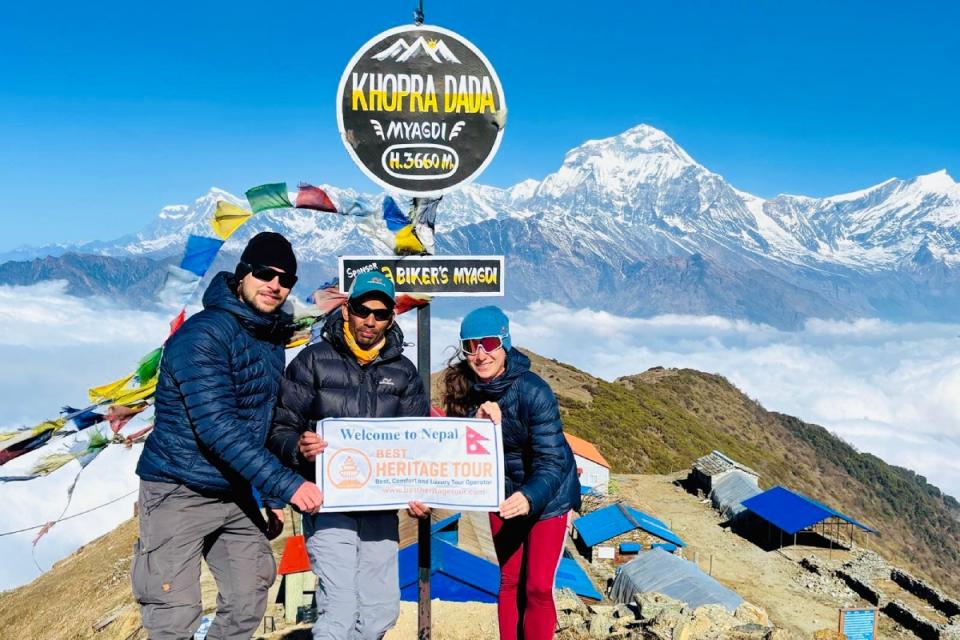
This route leaves the main trekking highway almost immediately after Ghandruk, redirecting you along an alpine ridge line that sits directly opposite the giant massif of Mount Dhaulagiri (8,167 m). You will climb steadily through ancient, moss-draped forests of oak and blooming spring rhododendrons before emerging completely above the timberline.
The crown jewel of this journey is the high-altitude day hike from the Khopra ridge up to the sacred Khayer Lake (4,660 m). Ringed by rugged cliffs, this high alpine bowl reflects the towering face of Mount Fang (Varaha Shikhar) on its glassy surface. It is a profoundly spiritual site revered by both Hindu and Buddhist pilgrims, where life feels blissfully removed from the modern world.
Why It Beats EBC
-
No Flight Redundancy: Unlike EBC, which requires a weather-dependent flight to Lukla, Khopra Danda is easily accessible via a short scenic drive from Pokhara.
-
Community-Led Impact: The lodges on this route are community-owned. Profits flow directly back into funding local schools and healthcare initiatives.
-
Lower Risk of Altitude Sickness: The ridge itself sits at $3,660\text{ m}$, keeping you well within a safe acclimatization zone for the majority of the trip.
2. The Pikey Peak Trek: Sir Edmund Hillary’s Favorite View of Everest
What if you still desperately want to see Mount Everest, but hate the thought of sharing the view with thousands of others? Look no further than the lower Solukhumbu’s best-kept secret: Pikey Peak.
The Trail Experience
When Sir Edmund Hillary - the first man to summit Everest alongside Tenzing Norgay Sherpa - as asked where his absolute favorite view of Mount Everest was, his answer wasn't the EBC trail or Kala Patthar. It was Pikey Peak.
The trek winds through the lower, gentler mid-hills of the Everest region, a landscape rich with old-growth pine forests, mani stones, and centuries-old monasteries like Thupten Choling. Standing at the prayer-flag-strewn summit of Pikey Peak (4,065 m) at sunrise, you are treated to a staggering visual sweep that spans from Dhaulagiri in the west all the way past Everest, Lhotse, and Makalu to Kanchenjunga in the east.
Why It Beats EBC
-
Solitude in the Kingdom of Everest: You get to look at the highest peaks on Earth in absolute silence, accompanied only by the whistling wind.
-
Pure Cultural Authenticity: Because this trail bypasses the heavy commercial infrastructure of Upper Khumbu, the Sherpa hospitality you encounter in these family-run teahouses is completely genuine and untouched by mass commercialism.
3. The Nar Phu Valley Trek: A Medieval Tibetan Enclave
For seasoned trekkers seeking a rugged, deeply historical adventure, the Nar Phu Valley Trek is a mind-bending leap back in time.
The Trail Experience
Hidden away behind the massive walls of the Annapurna Circuit, the restricted valleys of Nar and Phu were entirely closed to foreigners until 2002. Even today, strict government regulations require a special restricted area permit and a licensed guide to enter, keeping numbers exceptionally low.
The journey begins by splitting off from the Annapurna trail at Koto, plunging into a dramatic, narrow river canyon. As you emerge into the high, arid alpine valleys, you encounter the stone-walled medieval villages of Nar and Phu. Here, the local communities still practice an ancient variant of Tibetan Buddhism, herd yaks, and live according to centuries-old trans-Himalayan traditions. The trek concludes with a thrilling, challenging crossing of the high Kang La Pass (5,309 m), which treats you, to an eye-level view of the Annapurna massif.
4. The Api Himal Base Camp Trek: The Wild Far-West Frontier
If your definition of the ultimate trek means venturing to a place where international tourists are an absolute rarity, the Api Himal Base Camp Trek is the untouched frontier you are looking for.
The Trail Experience
Located within the remote Api Nampa Conservation Area in the far-western corner of Nepal, this expedition takes you to the foot of Mount Api (7,132 m) - the highest peak in Sudurpashchim Province. The journey requires an adventurous spirit, starting with a flight to Dhangadhi and a drive into the dramatic hills of Darchula.
The trail itself snakes through pristine subtropical valleys, climbing steeply along the rushing Chameliya River. You will pass through isolated villages inhabited by Doteli-speaking Hindu communities and high-altitude Bhote settlements, where lifestyle and culture have remained unchanged for decades. Stepping out of the final rhododendron forests into the vast, open alpine pastures of Api Base Camp (3,900 m), you will find yourself standing beneath a soaring, icy wall of 7,000-meter peaks. Nearby sits the sacred, untouched alpine waters of Kalidhunga Lake (4,200 m), a place of total, profound wilderness isolation.
Why It Beats EBC
-
The True Definition of Wilderness: While Everest hosts over 50,000 trekkers a year, Api Himal sees fewer than 500. It is raw, uncommercialized exploration at its finest.
-
Unmatched Hospitality: The locals look at travelers not as clients, but as honored guests, welcoming you with authentic warmth and curiosity.
5. The Mesokanto La Pass Trek: The High-Altitude Wilderness Adventure
For those torn between seeing Nepal’s legendary high-altitude turquoise lakes and tackling a challenging alpine pass without the crowds of the Thorong La, the Mesokanto La Pass Trek delivers an elite trekking experience.
The Trail Experience
This route offers an alternative, far more wild and isolated exit route from the breathtaking Tilicho Lake (4,919 m) - one of the highest lakes in the world. Instead of backtracking along the crowded main trails of the Annapurna Circuit, this route pushes west directly over the rugged, exposed Mesokanto La Pass (5,121 m).
The pass itself demands physical grit, proper acclimatization, and careful navigation across scree and rocky moraines. The reward is unparalleled: a dramatic descent into the arid, wind-scoured landscapes of Lower Mustang, dropping directly into the ancient apple-growing town of Marpha. It combines the high alpine drama of glacial lakes and technical passes with a deep dive into the unique Thakali culture of the Mustang district.
Planning Your Alternative Himalayan Adventure
Choosing one of these uncrowded alternatives to the Everest Base Camp trek means trading manicured tourist corridors for real, unpredictable mountain magic. Because these trails feature less commercial development, planning logistics - such as organizing restricted area permits, arranging remote ground transportation, and managing safety at altitude - requires deep local expertise.
This is exactly where we come in. At Best Heritage Tour, we don't believe in cookie-cutter itineraries. We specialize in tailoring safe, highly authentic, and sustainable journeys into Nepal’s hidden corners. Our wilderness guides are all locally hired experts who know every twist of the trail, every local homestay family, and the precise weather windows needed to keep you safe.
Let us help you discover the side of the Himalayas that most travelers miss. Get in touch with our travel planning team today to start designing your custom, crowd-free trek.
Ready to Experience the Untamed Side of Nepal?
Skip the tourist traffic jams and write your own unique Himalayan story. Contact our travel experts at Best Heritage Tour to secure your permits, customize your itinerary, and step onto the pristine trails of your dreams.
Phone / WhatsApp / Viber: +977-9851149197 / +977-9810043046
Email: info@bestheritagetour.com / bestheritagetour@gmail.com
Website: www.bestheritagetour.com
Office: Thamel Marg, Kathmandu, Nepal
Frequently Asked Questions (FAQs)
Are these alternative treks safe for solo travelers?
While some routes like Khopra Danda and Pikey Peak are physically manageable, several of these options - specifically the Nar Phu Valley and Api Himal treks - pass through strictly regulated, remote restricted zones. By Nepali law, solo trekking is banned in these regions; you must travel with a minimum group of two and be accompanied by a licensed trekking guide from an authorized agency.
What is the best time of year to embark on these off-the-beaten-path treks?
Like the classic routes, the optimal trekking windows are Autumn (October to November) for crystal-clear mountain skies and comfortable temperatures, and Spring (March to May) when the rhododendron forests are in spectacular, colorful bloom.
Do I need specialized mountaineering gear for passes like Mesokanto La or Kang La?
No technical mountaineering gear (like ropes, harnesses, or ice axes) is typically required under normal trekking season conditions. However, because these passes exceed 5,000 m and feature steep, loose scree, high-quality waterproof hiking boots with solid ankle support, adjustable trekking poles, and reliable microspikes (if early-season snow is present) are absolutely essential.
Author: Best Heritage Tour
Date: 2nd July, 2026