For adventurers around the world, the journey through the Khumbu region of Nepal is a pilgrimage of grit, beauty, and cultural discovery. Yet, no matter how many days you spend trekking past the terraced fields of Namche Bazaar or looking up at the majestic silhouette of Ama Dablam, everything converges at one final, decisive stretch: the trail from Gorakshep to Everest Base Camp.
This is the ground zero of Himalayan trekking. It is the boundary where the last permanent human settlement gives way to an empire of shifting ice, raw stone, and mountaineering history.
As a professional agency, we at Best Heritage Tour have guided hundreds of global explorers along this precise path. We understand that while the map makes this segment look short, the reality on the ground demands deep respect, careful preparation, and acute awareness of the environment.
Whether you are currently preparing your gear or sitting in a cozy teahouse visualizing the final push, this definitive guide provides the essential details on logistics, terrain, safety, and the true experience of navigating from Gorakshep to Everest Base Camp.
Understanding the Basics: Distance, Elevation, and Time
When planning this final segment, the first questions most trekkers ask are simple: How is the trail from Gorakshep to EBC? and How far is the EBC from Gorakshep?
To answer accurately, one must look beyond standard flat-ground mileage. At sea level, a few kilometers is a casual stroll; above 5,000 meters, it is a deliberate, oxygen-deprived endurance test.
Distance from Gorakshep to EBC
The absolute distance from Gorakshep to EBC is approximately 3.5 to 4.3 kilometers (2.1 to 2.7 miles) one way. Because the trail contours around the dynamic lateral moraine of the Khumbu Glacier - which shifts slightly every season due to glacial movement - the exact walking line can vary. For a complete round trip, you are looking at a total trekking distance of roughly 7 to 8.6 kilometers (4.3 to 5.4 miles) back to your base lodge in Gorakshep.
Elevation Metrics
The starting point at Gorakshep rests at an intimidating 5,164 meters (16,942 feet) above sea level. Your final destination, the historical marker of Everest Base Camp, stands at 5,364 meters (17,598 feet).
While a net elevation gain of exactly 200 meters (656 feet) looks modest on paper, the constant undulations of the ridge mean your legs will actually climb and descend significantly more than that net figure. Furthermore, at this altitude, the effective oxygen level is roughly 50% of what you experience at sea level. Every vertical meter gained requires double the respiratory effort.
Time Allocation
A fit trekker pacing themselves properly can expect to complete the one-way journey in 2 to 3 hours. The return journey back down to Gorakshep takes slightly less time - usually 1.5 to 2 hours - though fatigue can balance the scales.
We always advise our teams to allocate a full 4 to 6 hours for the complete round-trip experience. This window leaves plenty of buffer time to stand at the base camp, take photographs, talk with expedition teams during the spring season, and absorb the reality of your achievement without rushing.
Route Logistics at a Glance
|
Metric |
Measurement / Detail |
Practical Takeaway for Trekkers |
|---|---|---|
|
One-Way Distance |
3.5 km - 4.3 km (2.1 - 2.7 miles) |
Do not rush; maintain a steady, metered rhythm. |
|
Starting Altitude |
5,164 m / 16,942 ft (Gorakshep) |
The highest overnight sleeping point on the classic trek. |
|
Ending Altitude |
5,364 m / 17,598 ft (EBC) |
The absolute culmination of your outbound journey. |
|
Net Elevation Gain |
200 meters (656 feet) |
Gradual but undulating over complex glacial terrain. |
|
Average Round-Trip Time |
4 to 6 hours (including stops) |
Start early in the morning to maximize weather stability. |
|
Terrain Complexity |
High (Loose scree, boulders, moraine) |
High-top trekking boots and trekking poles are mandatory. |
How is the Trail from Gorakshep to EBC? & Is the trail from Gorakshep to EBC difficult?
To truly visualize the hike, you must understand the changing face of the terrain. The trail is entirely devoid of vegetation, presenting a stark, alpine lunar landscape that is both intimidating and profoundly beautiful. Here is exactly what you will encounter chronologically from the moment you step out of your Gorakshep lodge:
Phase 1: The Sandy Lakebed and the Initial Ridge (First 45 Minutes)
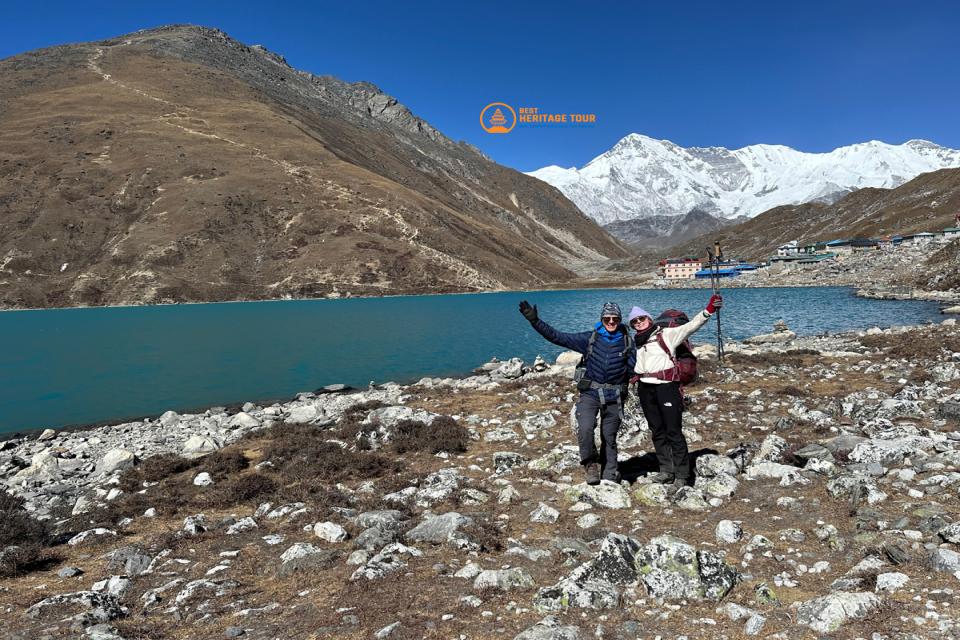
Leaving the small cluster of flat-roofed teahouses in Gorakshep, the trail begins deceptively gentle. You will walk across a vast, flat, sandy expanse which is actually the dry bed of an ancient glacial lake. The footing here is soft but predictable.
However, this flat terrain quickly terminates as the path directs you upward onto the lateral moraine of the Khumbu Glacier. This initial incline is a steady, loose gravel climb. As you ascend this first ridge, look back and to the west - the massive, snow-domed pyramid of Mt. Pumori (7,161m) dominates the sky, providing an extraordinary backdrop to your morning's efforts.
Phase 2: Traversing the Lateral Moraine (The Middle Hour)
Once you are established on top of the moraine ridge, the walk becomes an endless series of short ups and downs. This is the most technical portion of the trail. The path is not paved or fixed; it is a ribbon of single-track winding through a massive boulder field.
Gorakshep: 5,164m
↓ (Sandy Lakebed)
Moraine Ridge Climb → View of Mt. Pumori
↓ (Undulating Boulder Fields)
Glacial Edge Walk→ Sounds of shifting Khumbu Glacier
↓ (Final Steep Descent/Ascent)
Everest Base Camp: 5,364m → Khumbu Icefall Views
You will need to step over loose scree, navigate around large granite blocks, and occasionally step across frozen patches of meltwater. The terrain requires constant mental focus on foot placement.
To your right, the vast expanse of the Khumbu Glacier opens up. It looks like an enormous, grey, debris-covered river of stone. If you stop and listen quietly, you can frequently hear the glacier "groan" - low, rumbling acoustic thuds and sharp cracks as millions of tons of ice slowly grind down the valley beneath its protective layer of rock rubble.
Phase 3: The Final Approach and the Glacial Descent (Last 45 Minutes)
As you near the final kilometer, the massive wall of Nuptse (7,861m) towers directly overhead, its sheer rock faces and hanging ice cliffs cutting into the sky. The trail hugs the unstable edge where the moraine meets the active glacier.
To enter the official Base Camp area, the trail takes a sharp, steep descent directly off the moraine wall down onto the icy floor of the glacier itself. This section requires extreme caution, as the path consists of loose dirt and rolling gravel over a core of hard, blue glacial ice. Trekking poles are incredibly valuable here to maintain balance.
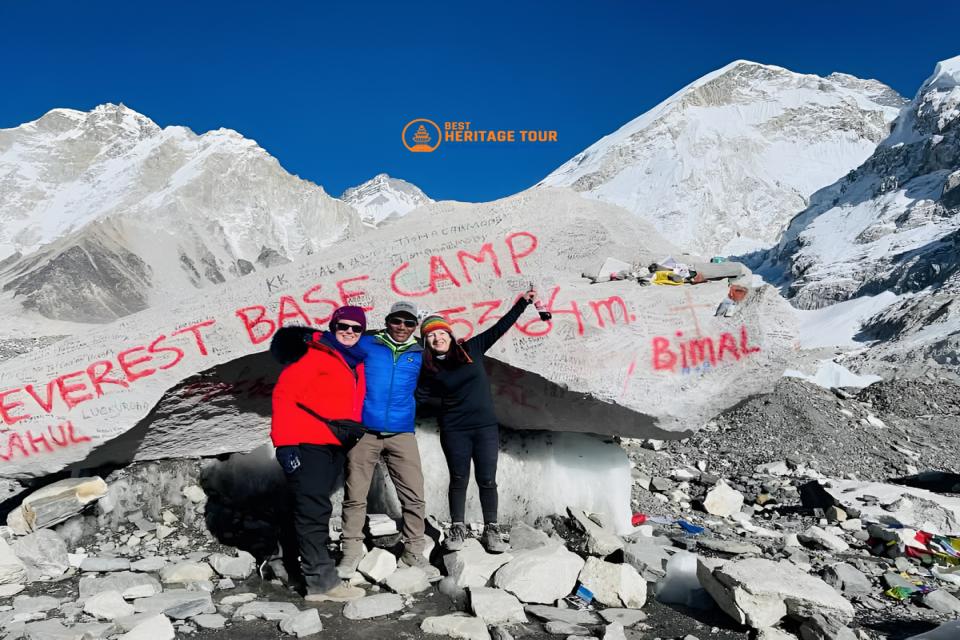
Once down on the floor, you weave through spectacular ice waves and towering seracs (glacial ice pillars) until you reach the iconic, prayer-flag-draped boulder that proclaims your arrival at Everest Base Camp.
The "Everest Hidden" Paradox
One of the most fascinating aspects of standing at Everest Base Camp is that you cannot see the actual summit of Mount Everest from the base camp itself.
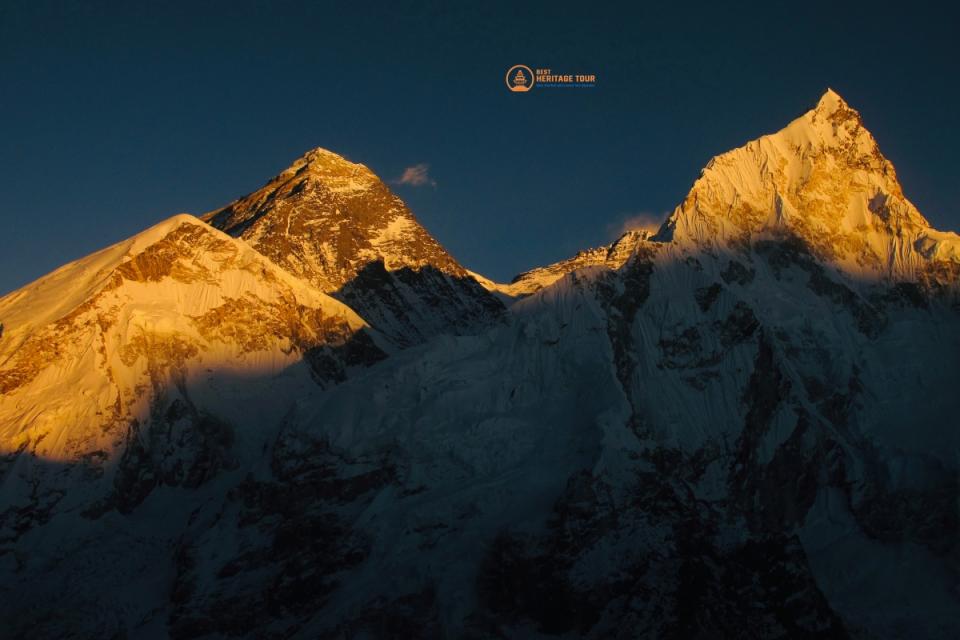
The towering West Shoulder of Everest and the massive ridge of Nuptse stand directly in the foreground, completely blocking the highest peak from view. To catch that legendary view of Everest’s black pyramid summit blowing snow flags in the wind, you must climb the nearby peak of Kala Patthar (5,545m), an excursion we typically lead early the following morning.
Visualizing the Destination: What You See at Everest Base Camp
Arriving at Everest Base Camp is an emotional milestone, but what you see depends entirely on the season of your visit.
Spring Expedition Season (March to May)
During the spring months, EBC transforms into a thriving alpine city of bright yellow and orange tents stretching across more than a kilometer of the glacier. This is the active climbing window. The air is filled with a sense of high-stakes adventure.
You will witness sherpas sorting gear, yak caravans arriving with food barrels, and climbers preparing for their rotations. Looking just beyond the edge of the camp, you will have a clear, front-row view of the terrifyingly beautiful Khumbu Icefall - a chaotic labyrinth of giant, shifting ice towers and bottomless crevasses that forms the first major obstacle on the route to the summit.
Autumn Trekking Season (September to November)
In the autumn, the climbing teams are largely absent, leaving the base camp quiet, pristine, and solemn. The primary visual marker is the historic boulder wrapped in hundreds of colorful Buddhist prayer flags left by thousands of trekkers who came before you.
While you won't see the tent city, the trade-off is unparalleled atmospheric clarity. The autumn air is crisp and completely clean, offering jaw-dropping photography opportunities of Nuptse, Lo La, and the frozen waves of the glacier under a deep indigo sky.
Conclusion
Reaching Everest Base Camp is a rare milestone that stays with you forever. The rocks, the cold wind, the fluttering prayer flags, and the sheer scale of the Himalayas create a profound sense of perspective.
Knowing exactly what to expect on the final kilometers from Gorakshep gives you the mental preparation needed to step out of your comfort zone and into history.
Are you ready to stand at the foot of the world's highest mountain? Let our experienced local team guide you safely along every step of the legendary Everest trail.
Plan Your Himalayan Adventure Today
Phone / WhatsApp / Viber: +977-9851149197 / +977-9810043046
Email: [email protected] / [email protected]
Website: www.bestheritagetour.com
Office: Thamel Marg, Kathmandu, Nepal
Author: Best Heritage Tour
Date: 27th May, 2026