At Best Heritage Tour, we believe that the soul of Nepal isn't just found in its ancient brick temples or the quiet serenity of its monasteries - it’s also found in the thin, crisp air thousands of feet above the earth. As a premier travel company based in the heart of Thamel, we’ve spent years guiding explorers through the rugged terrain of the Himalayas. But today, we’re looking upward.
If you are an adrenaline seeker or a traveler with a "bucket list" that never ends, you’ve likely faced the ultimate adventure dilemma: Pokhara Skydiving vs. Everest Skydiving. One offers a surreal glide over emerald lakes and the Annapurna massif, while the other is a world-class expedition to the very "top of the world." Both are life-changing, but they cater to very different types of thrill-seekers. In this comprehensive guide, we break down everything you need to know about skydiving in Nepal to help you decide which leap of faith is right for you.
The Landscape of Skydiving in Nepal
Nepal has rapidly transformed from a trekking-only destination into a global hub for extreme aerial sports. Unlike jumping over flat plains or coastal lines, skydiving in Nepal is an encounter with the giants of the world.
Whether you choose the Everest region or the Pokhara valley, you aren't just jumping out of a plane; you are entering a vertical wilderness. At Best Heritage Tour, we emphasize that while both locations share the Himalayan backdrop, the logistical, financial, and physical demands vary significantly.
1. Everest Skydiving: The "Elite" Leap
Often cited as the most elite skydiving experience on the planet, Everest Skydive is not just a jump - it is an 11-day expedition.
The Altitude and The Drop Zone
When we organize Everest skydiving trips, we aren't talking about your standard 10,000-foot jump. You will be exiting a B3 Eurocopter at staggering altitudes of up to 23,000 feet (approx. 7,000 meters). This puts you well above the height of many world peaks.
The primary drop zones are:
-
Syangboche Airport: Located at 12,402 ft (3,780 m).
-
Ama Dablam Base Camp: An even more extreme landing point at 15,000 ft (4,572 m).
The Technical Challenge
Because of the thin air at 23,000 feet, this is a HALO (High Altitude Low Opening) style jump. Divers must use supplemental oxygen systems. You’ll be wearing specialized thermal suits to combat the sub-zero temperatures.
Why Choose Everest?
-
The View: You are eye-to-eye with Mt. Everest (8,848.86m), Lhotse, and Nuptse.
-
The Prestige: You join a very small club of humans who have skydived in the highest mountain range on earth.
-
The Journey: The package usually includes a trek through the Khumbu region, allowing for proper acclimatization and a deep dive into Sherpa culture.
2. Pokhara Skydiving: The "Scenic" Thrill
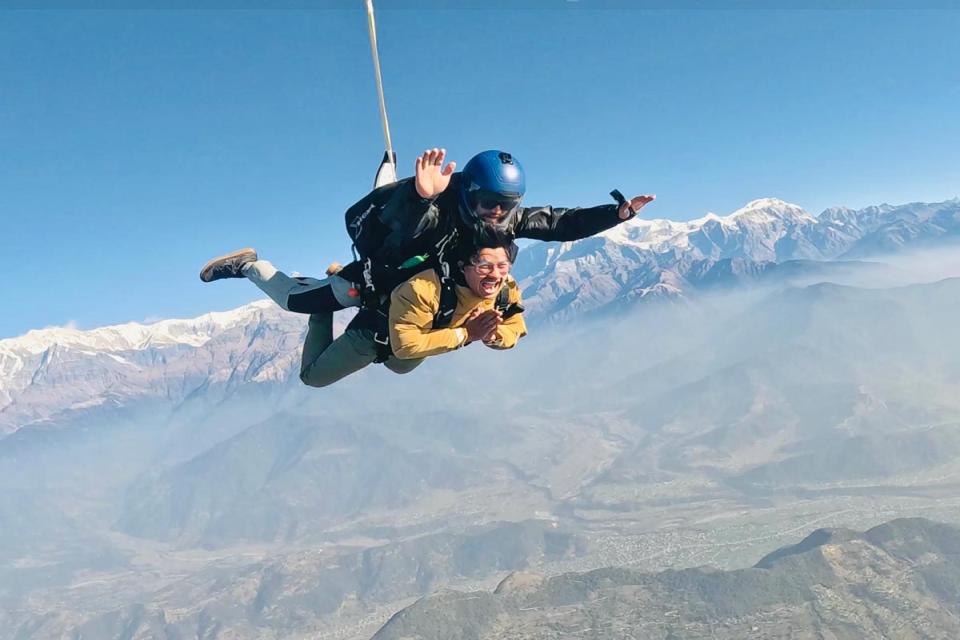
If Everest is the "extreme expedition," Pokhara Skydiving is the "accessible masterpiece." It is perfect for travelers who want the rush of a Himalayan jump without the month-long commitment or the five-figure price tag.
The Experience
Operating typically during the "Pokhara Skydive" event windows (usually November), this jump takes place near Pame Danda, west of the iconic Phewa Lake.
-
Jump Altitude: 11,000 to 13,000 feet.
-
Freefall: Approximately 45-50 seconds of pure adrenaline.
-
The Canopy Ride: A 5-7 minute glide where you can see the entire Annapurna Range, including Machhapuchhre (Fishtail), Dhaulagiri, and Manaslu.
Why Choose Pokhara?
-
Accessibility: You can complete the jump and be back at a lakeside café for a celebratory drink by sunset.
-
Weather Stability: Pokhara’s lower altitude offers a more stable weather window compared to the volatile Khumbu skies.
-
Cost-Effective: It provides a world-class skydiving experience at a fraction of the Everest cost.
Head-to-Head Comparison: Everest vs. Pokhara
To help you visualize the differences, we’ve compiled this comparison table:
|
Feature |
Everest Skydiving |
Pokhara Skydiving |
|---|---|---|
|
Drop Zone Altitude |
12,402 ft - 15,000 ft |
2,689 ft (Pame) |
|
Jump Height |
Up to 23,000 ft |
11,000 ft - 13,000 ft |
|
Oxygen Required? |
Yes (Supplemental Oxygen) |
No |
|
Duration |
9 - 11 Days (Expedition) |
1 - 3 Days |
|
Best Season |
Oct - Nov |
Nov (Specific Event Dates) |
|
Cost Range (Approx) |
$20,000 - $25,000 USD |
$700 - $1,200 USD |
|
Vibe |
Extreme, Rare, Expeditionary |
Scenic, Fun, Adventure-centric |
Logistics & Planning: What You Need to Know
Best Time to Skydive in Nepal
Timing is everything in the Himalayas. At Best Heritage Tour, we always advise our clients to aim for the Autumn (October to November) window.
-
Autumn: The air is washed clean by the monsoon, providing the sharpest visibility of the peaks. The winds are at their most predictable.
-
Spring (March to May): A secondary window, though sometimes hampered by pre-monsoon haze.
Physical Fitness & Requirements
You don't need to be an Olympic athlete, but you do need a healthy heart.
-
Age: Must be 18+ (or with parental consent for 16+ in some Pokhara packages).
-
Weight: Generally limited to 95kg (210 lbs) for safety reasons regarding parachute wing loading.
-
Health: No history of serious heart conditions or respiratory issues. For Everest, previous high-altitude experience is a massive plus, as the body needs to handle the rapid ascent in the helicopter.
Why Book Your Adventure with Best Heritage Tour?
Navigating the permits, helicopter charters, and safety protocols of Himalayan aviation is no small feat. This is where we come in. As a Thamel-based agency, Best Heritage Tour serves as your "boots on the ground."
-
Safety First: We only partner with operators who use USPA-certified instructors and international-standard equipment (including AAD - Automatic Activation Devices).
-
Seamless Logistics: From your arrival at Tribhuvan International Airport to your internal flights to Lukla or Pokhara, we handle the "boring stuff" so you can focus on the jump.
-
Cultural Immersion: We don't just send you to the drop zone. We integrate your skydiving trip with heritage tours of Kathmandu’s UNESCO sites, ensuring you see the soul of Nepal along with its heights.
The Verdict: Which One Should You Choose?
Choose Everest Skydiving if:
You are a high-net-worth adventurer looking for a "once-in-a-lifetime" trophy experience. If money is no object and you want to stand where very few have stood before, the Khumbu skies are calling you.
Choose Pokhara Skydiving if:
You are a traveler who loves adventure but also enjoys comfort. If you want a world-class tandem jump with stunning mountain views, followed by the vibrant nightlife of Pokhara’s Lakeside, this is your winner.
Conclusion
Whether you choose the high-stakes altitude of Everest or the breathtaking beauty of Pokhara, skydiving in Nepal is an experience that redefines your perspective on the world. You aren't just looking at the mountains anymore; you are part of their atmosphere.
At Best Heritage Tour, we are committed to making your Himalayan dreams a reality. From the moment you step into our office in Thamel to the second your feet touch the ground after your jump, we are with you every step of the way.
Ready to Take the Leap?
Don't let the adrenaline wait. Contact us today for customized skydiving packages, group discounts, and 2026/2027 booking dates.
Phone / WhatsApp / Viber: +977-9851149197 / +977-9810043046
Email: info@bestheritagetour.com / bestheritagetour@gmail.com
Website: www.bestheritagetour.com
Office: Thamel Marg, Kathmandu, Nepal
Author: Best Heritage Tour
Date: 26th March, 2026