For passionate anglers, globe-trotting sport fishers, and adventure-seeking travelers, the question is simple: Is fishing allowed in Nepal?
The short answer is yes, fishing is absolutely allowed in Nepal. However, casting a line into the rushing, glacial waters of the Himalayas is not a free-for-all. To preserve our fragile aquatic ecosystems and protect endangered species, the Government of Nepal strictly regulates angling. Navigating the legalities of fishing permits, seasonal bans, and location-specific zoning requires a clear understanding of our nation's environmental framework.
At Best Heritage Tour, we believe that sustainable angling tourism is one of the most immersive ways to experience Nepal's raw wilderness. From the thundering rivers of the far-western canyons to the serene, emerald waters of our mid-hill lakes, our ancient waterways host some of the most formidable freshwater game fish on Earth.
This comprehensive guide breaks down everything you need to know about fishing laws, permit acquisitions, target species, and ethical angling practices across Nepal.
The Legal Framework: Is Fishing Allowed in Nepal?
Nepal contains over 6,000 rivers and rivulets, alongside hundreds of high-altitude glacial lakes and low-land tectonic water bodies. To protect these diverse habitats, fishing is governed under the National Parks and Wildlife Conservation Act and managed directly by the Department of National Parks and Wildlife Conservation (DNPWC) alongside local Conservation Area Management Committees.
Essential Rules and Legal Mandates
-
Permit Requirements: It is strictly illegal for any foreign national or domestic traveler to fish in Nepal’s public waters, national parks, or conservation areas without a designated fishing permit.
-
Prohibited Methods: Traditional sport fishing using a rod, reel, and line (angling) or fly fishing is the only legally accepted method for tourists. The use of explosives (dynamiting), chemical poisoning, electric currents (electro-fishing), or massive commercial gill nets is strictly criminalized. Violators face hefty fines, confiscation of gear, and potential imprisonment.
-
Zoning Restrictions: Core zones of National Parks (such as Chitwan or Bardia) are completely closed to recreational angling to safeguard breeding grounds. However, designated buffer zones and specified wild rivers are fully accessible to licensed sport fishers.
Navigating Fishing Permits and Regulations in Nepal
Securing the correct legal paperwork is the critical first step of any angling expedition. Because authority is divided based on geography, the types of permits you need depend entirely on your destination.
Type of Permits Required
1. General Public River Permits
If you are planning a casual day of angling along major accessible river systems like the Trishuli, Bhote Koshi, or Kali Gandaki, you require an administrative fishing permit issued by local government authorities or regional DNPWC offices.
2. Conservation Area Permits
When fishing within legendary trekking zones like the Annapurna Conservation Area (ACA) or the Manaslu Conservation Area (MCA), you must obtain a specific Conservation Area Entry Permit via the National Trust for Nature Conservation (NTNC). Local Conservation Area Management Committees manage these beats, and separate local rod-and-line fees may apply at your lodge or village checkpoint.
3. National Park Buffer Zone Permits
For wilderness river systems that edge past protected sanctuaries - such as the mighty Babai or Karnali rivers near Bardia National Park - a specialized permit from the DNPWC headquarters in Kathmandu or the park's specific sector gates is mandatory.
Documentation Needed for Applications
To have our team at Best Heritage Tour secure these permits on your behalf, or if you are applying independently, you must provide:
-
A clear copy of your valid Passport (with at least 6 months validity).
-
A copy of your current Nepal Tourist Visa.
-
Two recent passport-size photographs.
-
A detailed fishing itinerary specifying exact dates, target rivers, and entry/exit points.
-
Detailed specifications of the angling gear you intend to deploy (such as spinning, baitcasting, or fly gear).
What Makes Fishing in Nepal Unique Compared to Other Countries?
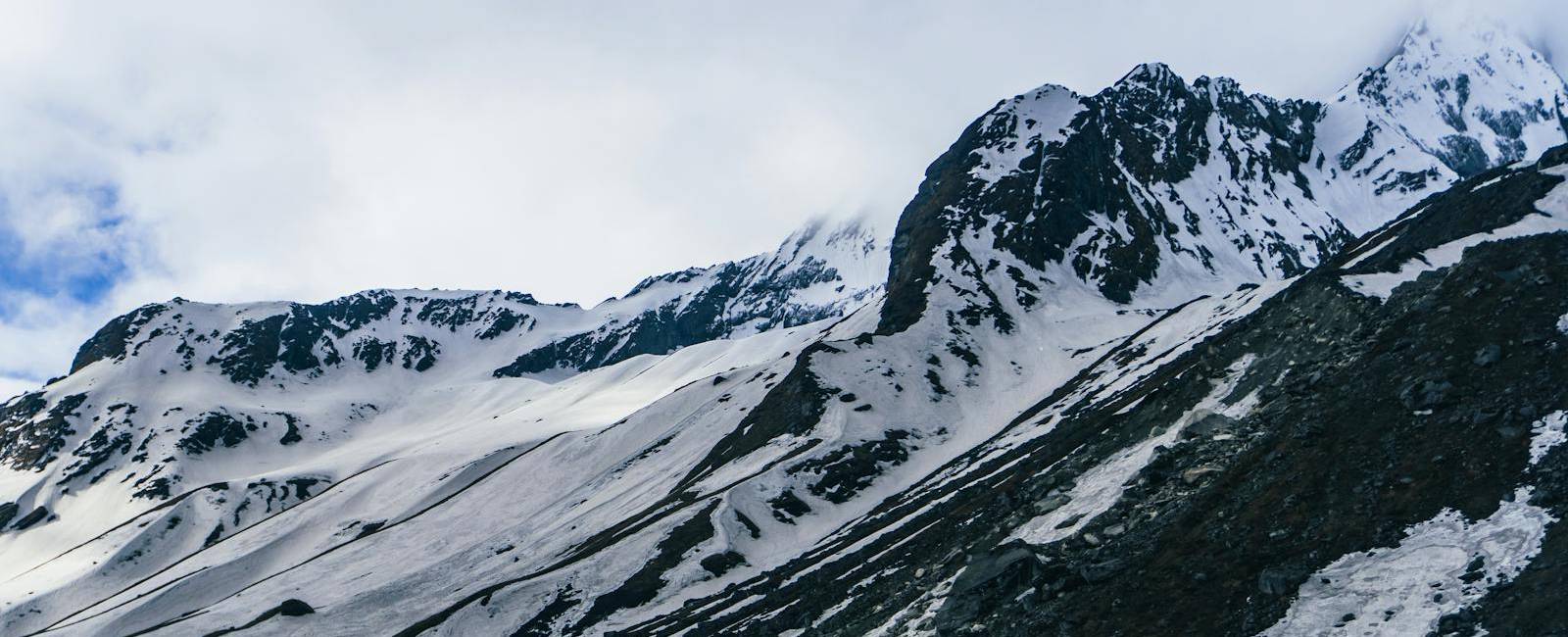
Angling in Nepal is completely distinct from fishing the calm lakes of North America or the managed chalk streams of Europe. It is an extreme, high-octane sport set against the backdrop of the highest mountain range on earth.
-
Extreme Topography and Heavy Currents: Nepal’s rivers drop thousands of vertical meters over incredibly short horizontal distances. This creates violent, fast-flowing, oxygen-rich waters filled with Class II to Class V rapids, deep pocket waters, and massive churning eddies. The fish that survive here are specialized, hyper-muscular apex fighters that leverage the intense current to break your line.
-
Glacial Melts vs. Monsoon Rhythms: Our river dynamics are completely driven by cosmic seasonal cycles. Anglers must contend with changing water clarity based on glacial silt running down from high peaks, or massive water fluctuations dictated by the annual monsoon.
-
A Fusion of Fishing and Wilderness Expeditions: Fishing in Nepal is rarely a stationary affair. The premium angling locations are completely remote, tucked deep inside jungle canyons or far-western valleys. To reach them, we integrate multi-day wilderness river rafting and riverside camping. You fish untouched river beats by day and camp on pristine gravel bars under the stars by night.
Best Fish Species Found in Nepal’s Rivers and Lakes
The cold, fast-flowing aquatic ecosystems of Nepal host over 200 native fish species. For sport fishers, our waters are home to legendary freshwater fighters.
Golden Mahseer (Tor putitora)
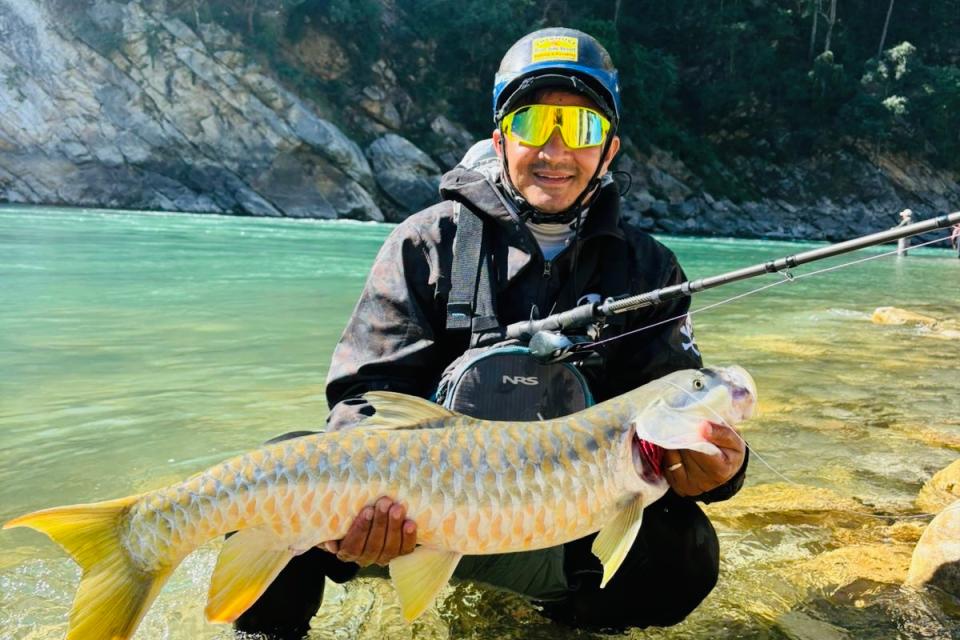
Affectionately known as the "Tiger of Himalayan Rivers," the Golden Mahseer is the crown jewel of Asian freshwater sport fishing. This golden-scaled predator is a member of the cyprinids family and can grow to massive sizes, with historical specimens crossing 100 pounds.
Goonch / Giant River Catfish (Bagarius yarrelli)
For the heavy-tackle angler, the Goonch is a prehistoric river monster. This giant, bottom-dwelling catfish features a mottled, camouflaged body and can reach weights exceeding 150 pounds in the deep gorges of the Karnali and Mahakali rivers.
Snow Trout (Schizothorax / Asala)
Despite its common name, the Snow Trout is actually a specialized member of the carp family native to cold, high-altitude mountain streams. Adorned with fine silver scales and uniquely adapted mouths to graze algae off torrent rocks, the Asala is the ultimate target for light-tackle enthusiasts and fly fishermen.
Other Notable Species
Anglers will regularly encounter aggressive predators like the Murrel (Snakehead) in slower river stretches, various species of Catfish (Tengra and Vacha), and introduced Brown Trout and Rainbow Trout thriving beautifully in specialized high-altitude conservation streams and private hatcheries in regions like Nuwakot and Sindhupalchok.
Spotlight: Golden Mahseer Fishing in Nepal
Because Golden Mahseer Fishing in Nepal is recognized globally as an elite angling experience, it requires its own tactical planning. The species is currently listed as Endangered by the IUCN, which transforms responsible angling from a mere choice into an absolute ethical mandate.
Prime Rivers for Golden Mahseer
-
The Karnali and Seti-Karnali System: Located in far-western Nepal, this remains the most pristine, wild, and untouched river system for trophy Mahseer. Free from major dams, its crystal-clear water, deep canyon pools, and wide gravel bars hold legendary fish.
-
The Babai River: Running through the heart of Bardia National Park, the Babai valley offers excellent, highly regulated sport fishing windows where massive Mahseer cruise alongside jungle landscapes populated by wild rhinos and tigers.
-
The Trishuli and Kali Gandaki Rivers: More accessible from Kathmandu and Pokhara, these rivers offer excellent pocket-water angling along major confluences, perfect for shorter, dedicated fishing itineraries.
Best Times to Fish in Nepal
Timing your expedition to match the complex weather patterns of the Indian subcontinent is the difference between a successful trip and staring at an un-fishable wall of mud.
Spring Season (March to May) - Peak Window
This is widely considered the absolute best window for trophy Golden Mahseer fishing in Nepal. As the winter chill recedes, water temperatures rise, causing the fish to break out of their winter dormancy and feed aggressively. River flows are stable, clear, and perfectly manageable.
Autumn Season (October to November) - Excellent Window
Immediately following the retreat of the summer monsoon, the autumn season brings incredibly stable weather, blue skies, and clearing rivers. As water levels drop, large fish consolidate into predictable deep pools and river confluences. This is a spectacular time for both spinning and fly fishing.
Monsoon Season (June to September) - Strictly Closed / Prohibited
During the monsoon, heavy rains turn Himalayan rivers into violent, chocolate-colored torrents carrying immense sediment and uprooted debris. Fishing is completely impossible, highly dangerous, and legally prohibited in most regions as this coincides with the primary spawning and breeding cycles of our native fish.
Winter Season (December to February) - Low Activity
While the water is crystal clear, high-altitude glacial runoffs drop river temperatures significantly. Fish retreat to the deepest sanctuary pools and their metabolic rates slow down drastically, making them highly selective and difficult to entice.
Conservation Ethics: The Mandatory Catch-and-Release Policy
As a leading sustainable travel operator in the Himalayas, Best Heritage Tour champions a strict conservation-first philosophy. Due to environmental pressures, poaching, and climate impacts, 100% Catch-and-Release is the universal golden standard for all sport fishing tours we manage.
Best Practices for Ethical Fish Handling
1. Use Barbless Hooks: Prerequisite Setup.
Always crimp your barbs or utilize dedicated barbless single hooks. This minimizes mouth trauma and ensures a rapid, effortless unhooking process.
2. Keep the Fish Wet: Landing the Catch.
Never drag a fish onto hot dry sand or rocks, which destroys their protective slime coat. Use a knotless, rubberized landing net and keep the fish submerged in shallow water.
3. Handle with Wet Hands: Uncoupling and Prep.
If you must lift the fish for a quick verification photograph, always wet your hands first. Support the fish horizontally with one hand under the belly and one gripping the tail wrapper-never hold a Mahseer vertically by its gills.
4. Revive and Release: Final Recovery.
Hold the fish facing upstream into a gentle river current. Cradle it softly until it regains its equilibrium, pumps water cleanly through its gills, and swims out of your hands under its own power.
Conclusion
Fishing in Nepal is far more than a recreational pastime-it is a pilgrimage into some of the most dramatic, untouched river canyons on our planet. By respecting local fishing permits, adhering to conservation regulations, and practicing strict catch-and-release ethics, we can ensure that future generations of anglers will continue to hook the legendary "Tiger of the Himalayan Rivers."
Navigating the logistics of remote river access, processing seasonal government permits, arranging safe wilderness rafting support, and locating high-yield fishing beats can be highly complex. Our team at Best Heritage Tour specializes in custom, fully guided, low-impact angling expeditions across Nepal's premier river systems. We handle every legal permit, coordinate expert local river guides, provide premium wilderness camping arrangements, and ensure your journey is completely compliant, seamless, and unforgettable.
Contact Best Heritage Tour to Design Your Custom Fishing Itinerary:
Phone / WhatsApp / Viber: +977-9851149197 / +977-9810043046
Email: info@bestheritagetour.com / bestheritagetour@gmail.com
Website: www.bestheritagetour.com
Office: Thamel Marg, Kathmandu, Nepal
Author: Best Heritage Tour
Date: 25th June, 2026