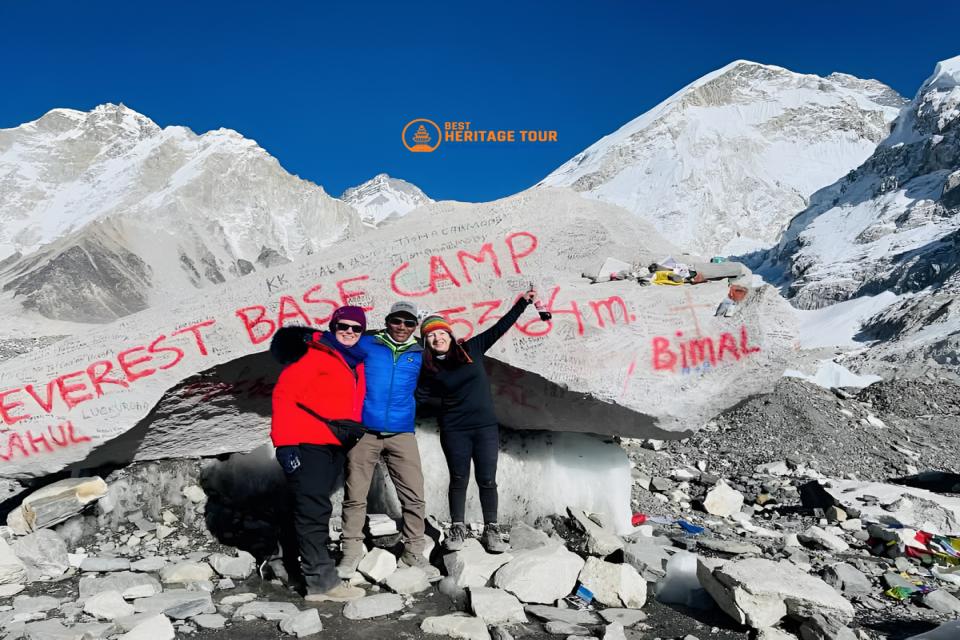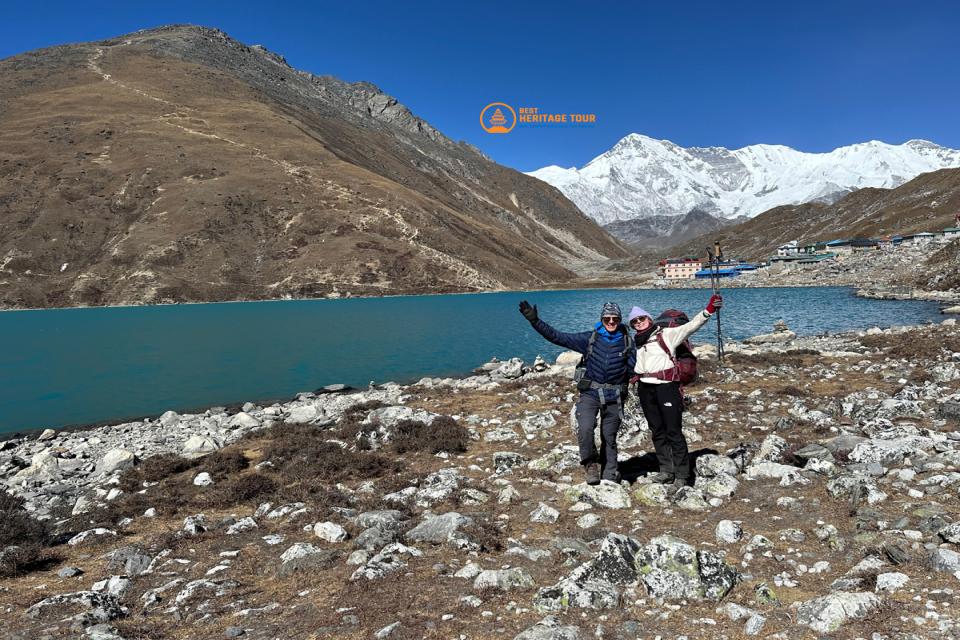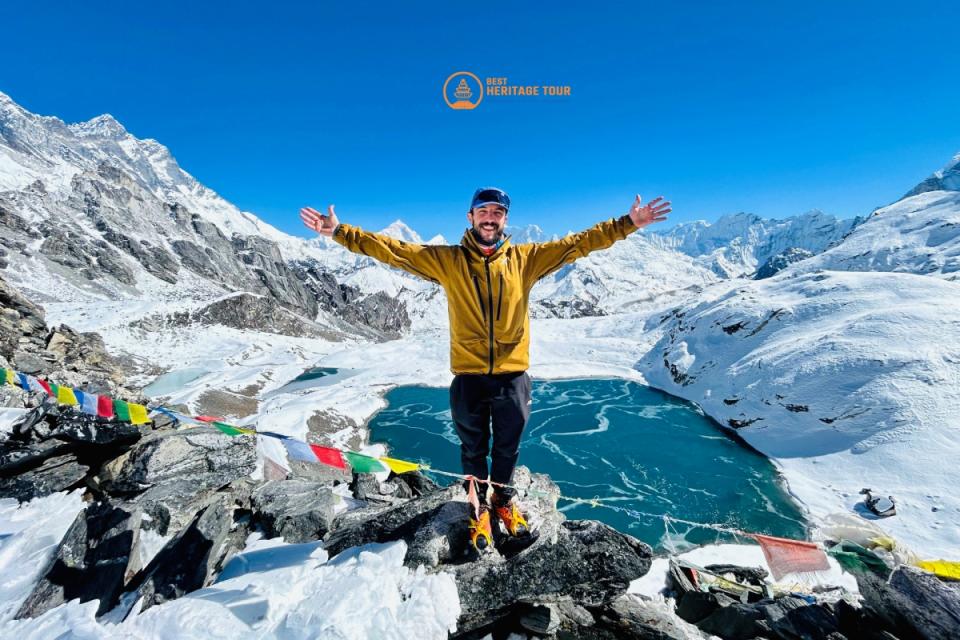
Standing at 4,790 meters beside the cobalt-blue waters of Dudh Pokhari, watching the sunrise illuminate the sheer face of Mt. Everest, Lhotse, Makalu, and Cho Oyu from the top of Gokyo Ri (5,357m) is a life-changing experience. The Gokyo Lakes Trek offers a quieter, visually stunning alternative to the classic Everest Base Camp route. However, trading the crowded main trails for pristine glacial lakes and dramatic high-altitude ridges requires serious physical preparation.
As a local travel agency organizing treks in Khumbu region, we know that the difference between an grueling, exhausting ordeal and an unforgettable adventure comes down to how you prepare. The trail doesn’t require technical climbing skills, but it does demand relentless endurance, strong legs, and cardiovascular resilience.
Here is our comprehensive, guide-tested fitness strategy to help you prepare your body and mind for the iconic Gokyo Lakes route.
Understanding the Physical Demands of the Gokyo Lakes Route
Before lace up your boots and start training, you need to understand what your body will face out on the trail. This isn't a weekend stroll; it is a multi-day alpine trek that tests your endurance over a sustained period.
-
Daily Trekking Duration: You will be walking for 5 to 7 hours every day for roughly 10 to 12 consecutive days.
-
Challenging Elevation Profile: The journey begins at Lukla (2,860m) and climbs steadily past Namche Bazaar (3,440m) up to the Gokyo Valley. Your final pushes will take you past the 5,000-meter mark.
-
Variable Alpine Terrain: Expect steep stone staircases, narrow dirt paths, exposed ridges, and shifting lateral moraines across the massive Ngozumpa Glacier.
-
Load-Bearing Endurance: Even with our dedicated porters carrying your main duffel bag, you will carry a daypack weighing 5 to 8 kg containing your water, layers, camera, and essentials.
Phase-Based 12-Week Training Routine
We highly recommend starting a structured fitness regimen at least 8 to 12 weeks before departure. If you are starting from a sedentary baseline, extend this to 16 weeks to allow your joints and muscles to adapt safely.
Phase 1: Aerobic Base Building (Weeks 1-4)
Your main focus early on is optimizing your cardiovascular system to utilize oxygen efficiently. This structural foundation expands your lung capacity and helps your heart pump blood effectively, which is vital when oxygen levels drop to nearly 50% at high altitudes.
-
Cardio Sessions: 3 to 4 times a week, complete 40 to 60 minutes of low-impact, steady-state cardio (Zone 2 training). Excellent options include brisk incline walking, swimming, or cycling.
-
Leg Strength Basics: Introduce bodyweight movements twice a week to strengthen your joints. Focus on air squats, step-ups, and calf raises.
-
Weekend Hike: Dedicate one day to a 2 to 3-hour walk on local trails or rolling hills, wearing comfortable walking shoes and a light pack.
Phase 2: Strength and Progressive Incline Training (Weeks 5-8)
During this phase, we introduce targeted resistance training to build the muscle endurance needed to climb thousands of stone steps without experiencing muscle failure.
-
Trek-Specific Strength Circuit: Focus on compound movements twice a week. Perform 3 sets of 15 reps of the following exercises:
-
Weighted Goblet Squats: Builds quad and glute power for long ascents.
-
Walking Lunges: Replicates the uneven stepping motion of rocky terrain.
-
Step-Ups onto a Bench: Excellent for developing single-leg stability.
-
Planks and Dead Bugs: Strengthens your core and protects your lower back while carrying a backpack.
-
-
Incline Conditioning: Swap one standard cardio session for 45 minutes on a stairclimber machine or a treadmill set to a 10% to 12% incline.
-
Weighted Weekend Hike: Increase your outdoor time to 4 hours, and start wearing your actual trekking boots along with a 5 kg backpack.
Phase 3: Peak Conditioning and Simulation (Weeks 9-11)
This phase replicates the multi-day fatigue you will experience in the Himalayas.
-
Back-to-Back Long Hikes: Hike for 5 to 6 hours on Saturday, followed by a 3 to 4-hour hike on Sunday. This teaches your body to recover overnight and perform well on tired legs.
-
Full Pack Weight: Increase your training backpack weight to 8 kg to ensure your shoulders, core, and hips are fully adapted before your trip.
-
High-Intensity Intervals (HIIT): Add one weekly session of hill repeats or rapid stair climbing to boost your VO2 max.
Phase 4: The Taper (Week 12)
Reduce your workout volume by 50 to 60%. Avoid heavy lifting or long, grueling hikes during this final week. Focus on light stretching, mobility drills, and ample sleep to allow your muscles to fully repair, ensuring you arrive in Kathmandu feeling refreshed and ready.
Key Fitness Metrics to Aim For
To help you gauge your preparedness, we use a few simple field benchmarks. If you can comfortably complete the following tasks before your departure, your body is ready for the Gokyo trail:
|
Fitness Benchmark |
Target Performance Standard |
Trek-Specific Benefit |
|---|---|---|
|
Incline Treadmill Test |
Walk at 4.5 km/h at a 10% incline for 45 minutes continuously. |
Simulates the steady uphill climb from Phortse Tenga to Machhermo. |
|
Stair Endurance |
Climb 40 flights of stairs without needing to pause for breath. |
Prepares your quads for the steep stone steps leading into Namche Bazaar. |
|
Endurance Hiking |
Complete a 15 km outdoor hike with an 8 kg pack and feel fully recovered the next morning. |
Mimics a standard day on the trail, building necessary structural durability. |
Mental Resilience and Altitude Management
Physical training is only half the battle; high-altitude trekking is heavily psychological. The thin air above 4,000 meters makes every step feel twice as heavy, requiring strong mental focus.
The Art of the "Sherpa Pace"
The most common mistake western trekkers make is walking too fast early in the day. Our guides will teach you the Bistari, Bistari (slowly, slowly) approach. Keeping your heart rate down prevents lactic acid buildup and gives your body more energy to adjust to the thinning air.
Breathing Techniques
Incorporate box breathing or deep diaphragmatic breathing into your training routine. Learning to take deep, rhythmic belly breaths helps stabilize your nervous system when you feel short of breath at high altitudes, preventing anxiety and early fatigue.
Conclusion
Training for the Gokyo Lakes Trek is a rewarding journey that begins months before you step onto the trail. By building a reliable aerobic base, strengthening your legs, and arriving with the right mindset, you ensure that your high-altitude experience is safe, comfortable, and truly unforgettable.
Our team provides comprehensive support every step of the way, flexible itineraries with built-in acclimatization days, and experienced local guides who know these mountains intimately.
Phone / WhatsApp / Viber: +977-9851149197 / +977-9810043046
Email: info@bestheritagetour.com / bestheritagetour@gmail.com
Website: www.bestheritagetour.com
Office: Thamel Marg, Kathmandu, Nepal
Frequently Asked Questions
Is the Gokyo Lakes Trek harder than the standard Everest Base Camp (EBC) Trek?
The difficulty is quite comparable, but they present different challenges. The standard EBC trek has a more uniform, heavily trafficked trail. The Gokyo Lakes Trek involves steeper climbs over rougher terrain, particularly when crossing the Ngozumpa Glacier moraine and ascending the steep gravel path up Gokyo Ri. However, Gokyo offers a more gradual ascent profile early on, which can make acclimatization easier.
Can a beginner trek to Gokyo Lakes?
Yes, motivated beginners can absolutely complete this route, provided they commit to a consistent 3 to 4-month training program beforehand. Choosing a well-paced itinerary that includes dedicated acclimatization days in Namche Bazaar and Machhermo is also essential for a safe, successful journey.
Author: Best Heritage Tour
Date: 10th July, 2026