The classic trekking corridors of Nepal are changing. As modern infrastructure and road construction push deeper into the Annapurna and Everest regions, purist trekkers face a modern dilemma: where do you go to find the raw, unfiltered, and uncompromising Himalaya?
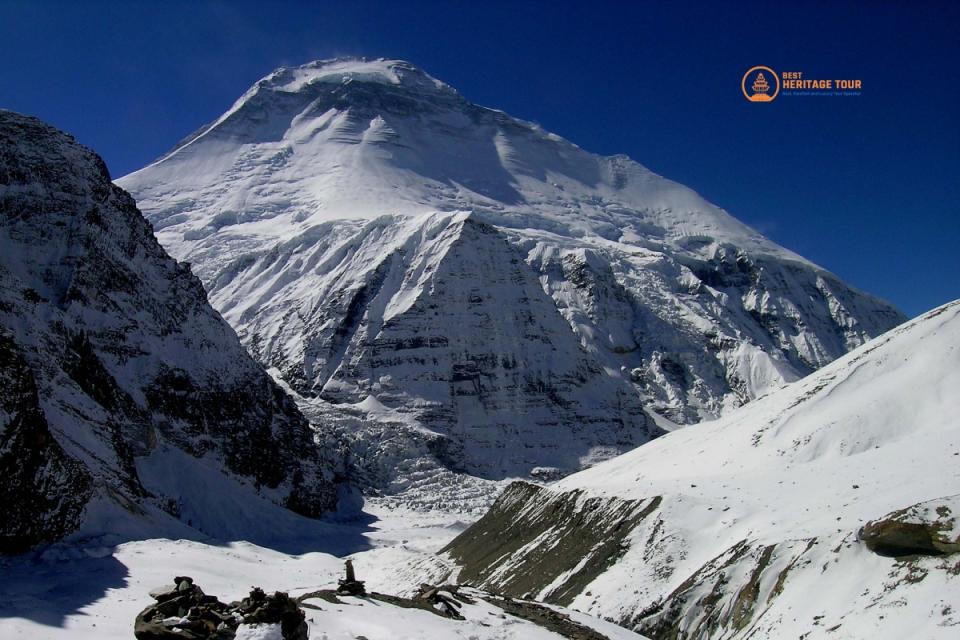
For those who crave authentic isolation, jagged landscapes untouched by modernization, and the visceral thrill of high-altitude expedition-style exploration, our answer at Best Heritage Tour is clear. You must head west toward Mount Dhaulagiri (8,167 meters / 26,795 feet), the seventh-highest mountain on Earth.
The Dhaulagiri Circuit Trek in 2027 stands out as the definitive objective for off-the-beaten-path trekkers and remote mountain lovers. It is not just a hike; it is a full-scale alpine undertaking. This comprehensive guide details what makes this journey unique, how to prepare for its considerable physical demands, and why navigating its massive glacial valleys remains one of the ultimate wilderness achievements in Asia.
Why Choose Dhaulagiri Circuit Trek in 2027?
If you want to understand why choose Dhaulagiri Circuit Trek in 2027, look closely at how global travel trends are shifting. More than ever, travelers are seeking authentic isolation over commercialized itineraries. While iconic trails now feature heated teahouses and espresso machines, the Dhaulagiri massif remains fiercely protected by its formidable geography.
-
Commercial Tea House Trails → Infrastructure Growth → High Crowds / Developed Roads
-
Dhaulagiri Circuit Route → Protected Geography → Raw Wilderness / Pure Camping
Choosing this route means steping backward in time to the golden age of Himalayan exploration. There are three core reasons why this specific circuit should be at the top of your adventure calendar:
-
True Wilderness Integrity: The route bypasses modern roads entirely. Once you leave the lower farming villages of the Myagdi region, you enter an alpine landscape devoid of permanent human settlements, electricity grids, or cellular service.
-
Unrivaled Glacial Proximity: Unlike treks that view major peaks from afar, this circuit places you directly on the massive Chonbardan Glacier. You will camp directly beneath the sheer, ice-draped North Face of Dhaulagiri I.
-
A Complete Ecological Cross-Section: The journey begins in lush, subtropical terraced fields at less than 1,000 meters elevation, cuts through deep rhododendron and oak forests, enters rugged gorges, and eventually emerges into a high-altitude arctic desert before dropping into the wind-swept Mustang valley.
Is Dhaulagiri Circuit Trek Very Difficult and Less Crowded?
This is the most common question our travel specialists receive. To put it simply: yes, the Dhaulagiri Circuit Trek is very difficult and less crowded.
While popular destinations like Everest Base Camp or the classic Annapurna Circuit see tens of thousands of hikers annually, Dhaulagiri welcomes only a fraction of that number - often fewer than a few hundred trekkers over an entire climbing season. You can easily walk for days without encountering any other trekking groups.
The reason it remains so quiet is inextricably linked to its physical demands. The trek requires crossing two formidable high-altitude passes back-to-back: French Pass (5,360 meters / 17,585 feet) and Dhampus Pass (5,244 meters / 17,205 feet).
Furthermore, you will spend multiple consecutive nights sleeping on snow and moving ice at elevations exceeding 4,000 meters. The lack of standard permanent lodges means that absolute self-sufficiency is mandatory. This naturally thins out the crowds, leaving the majestic valleys exclusively to dedicated, experienced mountain lovers.
How Difficult is the Dhaulagiri Circuit Trek? An Honest Breakdown
To help you evaluate your readiness, we believe in providing a transparent assessment of the challenges involved. Understanding exactly how difficult is the Dhaulagiri Circuit Trek requires looking at several distinct environmental variables:
1. High Altitude and Extreme Elevation Profiles
The elevation gain on this trek is rapid and sustained. You will start your foot journey at Darbang (approx. 1,110m) and climb steadily up into the clouds. The highest sleeping point is at Dhaulagiri Base Camp, situated at roughly 4,748 meters (15,577 feet), followed by high-altitude camps near the passes. Acclimatization must be approached methodically; skipping rest days on this route can have severe health consequences.
2. Demanding Terrain and Glacial Navigation
This is not a manicured trail. You will encounter:
-
Slippery, unstable scree fields and active rockfall zones.
-
Sustained marching over moraine (accumulated glacial debris) and slick blue ice.
-
Steep, exposed sections where a single misstep requires absolute focus and stable footing.
-
Deep winter snowpacks that can obscure route markers, requiring expert navigation.
3. Volatile Arctic Weather Systems
Weather around the Dhaulagiri massif is notoriously unpredictable. The mountain creates its own localized weather patterns. Even during peak trekking seasons, you must be prepared for sudden blizzards, sub-zero wind chills down to -15°C (5°F) at night, and dense valley fogs that reduce visibility to just a few meters.
|
Trek Metric |
Dynamic Challenge Level |
Detailed Technical Description |
|---|---|---|
|
Physical Endurance |
Strenuous / Extreme |
Requires 6-8 hours of sustained uphill hiking daily with a daypack over loose rock, snow, and steep inclines. |
|
Technical Difficulty |
Moderate Alpine |
No vertical ice climbing or rope work is standard, but crampons/microspikes and trekking poles are mandatory for glacier travel. |
|
Accommodation Type |
100% Expedition Camping |
No teahouses or lodges exist for 5 Days of the itinerary; self-reliance is absolute. |
|
Remoteness Factor |
High Isolation |
Zero cell coverage, no road access, and emergency helicopter evacuations are strictly weather-dependent. |
The Ultimate Camping Trek to Dhaulagiri Circuit Trek
Because there are no lodges along the high portions of this route, executing a true camping trek to Dhaulagiri Circuit Trek requires meticulous logistics, heavy-duty gear, and an experienced mountain crew. At Best Heritage Tour, we treat this itinerary like a serious mountaineering expedition.
Our support teams handle the transport of heavy canvas mess tents, insulated sleeping domes, kitchen setups, fresh ingredients, and emergency medical equipment, including supplementary oxygen cylinders and satellite communication devices.
What it’s Like to Camp in the Shadow of Giants
Imagine unzipping your tent door at dawn at Italian Base Camp (3,660m) or Dhaulagiri Base Camp (4,748m). There are no concrete buildings or bustling dining halls here. Instead, you are surrounded by an amphitheater of sheer rock walls and hanging glaciers. The air is cold, crisp, and completely silent, broken only by the distant, thunderous rumble of a hanging serac discharging down the West Face.
Living in a self-sustained camp connects you deeply to the natural rhythm of the mountains. Our professional kitchen staff prepares hot, nutrient-dense meals right in the middle of glacial moraines, ensuring your body gets the caloric intake needed to recover from grueling days on the trail.
Step-by-Step Tactical Route Overview
To fully visualize this wilderness journey, here is a breakdown of how a premier, safely paced circuit unfolds over the high-altitude terrain.
Kathmandu → Pokhara → Darbang (Start)
→Muri (Magar Village)
→ Boghara (Last Permanent Settlement)
→ Italian Base Camp (3,660m - Acclimatization)
→ Dhaulagiri Base Camp (4,748m - Glacial Moraine)
→ French Pass (5,360m) -> Hidden Valley (5,050m)
→ Dhampus Pass (5,244m) -> Jomsom (Exit) -> Pokhara
Phase 1: The Lowlands and Cultural Immersion
The journey departs from the lakeside city of Pokhara, driving through rugged dirt roads to Darbang. The initial trekking days trace the banks of the roaring Myagdi Khola river. You will pass through charming, traditional villages inhabited by the Magar and Gurung communities, such as Muri and Boghara. These early days are characterized by lush subtropical vegetation, terraced rice paddies, and warm local interactions.
Phase 2: Entering the Alpine Wilderness
Beyond the village of Boghara, civilization fades away. The trail climbs steeply through dense, pristine bamboo and rhododendron forests into the uninhabited upper canyon. You pass Dobang and Sallaghari, camp settings enveloped by towering old-growth trees. As you reach Italian Base Camp (3,660m), the valley walls shoot straight up into the sky, and the tree line gives way to alpine grasses and shattered rock. This is where our team schedules a mandatory acclimatization rest day.
Phase 3: The Glacial High Country
Leaving Italian Base Camp, you cross a challenging, narrow gorge prone to rockfall and step onto the Chonbardan Glacier. The trek to Dhaulagiri Base Camp (4,748m) is a slow, steady march over rubble, ice hills, and moraine ridges.
From base camp, the route tackles the spectacular French Pass (5,360m). Reaching the top reveals a panoramic view of the Hidden Valley, a high-altitude, desolate plateau reminiscent of the Tibetan landscape. After camping in the freezing expanses of the Hidden Valley (5,050m), you cross Dhampus Pass (5,244m), showcasing expansive views of the Annapurna range and the deep Kali Gandaki Gorge.
Phase 4: Descending into the Mustang Rain Shadow
From the snowy crest of Dhampus Pass, the trail plummets down a steep, dusty descent of over 2,500 vertical meters. The landscape transforms dramatically into an arid desert as you reach Marpha, a beautiful white-stone Thakali village famous for its apple orchards. The trek concludes at Jomsom, where a short mountain flight or drive takes us back to Pokhara for celebratory hot showers and well-earned meals.
Packing for Dhaulagiri Circuit Trek
When embarking on a pure camping trek, your gear selection can make or break your trip. We often get question like: What to pack for the Dhaulagiri Circuit Trek? Here is a checklist of critical equipment required for the high passes:
-
Footwear: Sturdy, deeply grooved, waterproof mountaineering or heavy trekking boots (broken in well in advance) along with high-quality merino wool socks.
-
Traction: Lightweight microspikes or flexible crampons for secure trekking across slick, hard-packed glacial ice.
-
Sleeping Systems: A premium, four-season down sleeping bag rated comfortably to at least -20°C (-4°F), paired with an insulated sleeping mat (high R-value).
-
Layering System: A thick, high-loft down parka, windproof and waterproof Gore-Tex outer shells, mid-weight fleece layers, and moisture-wicking thermal underwear.
-
Eye Protection: Category 3 or 4 glacier glasses with side shields to prevent snow blindness caused by intense UV rays reflecting off the snow fields.
Conclusion
The Dhaulagiri Circuit Trek in 2027 represents one of the final remaining bastions of raw, untamed Himalayan adventure. It is an investment in pure exploration - challenging your boundaries, stripping away modern distractions, and rewarding you with mountain vistas that very few human beings will ever see with their own eyes. It is tough, it is isolated, and it is unforgettable.
Are you ready to leave the crowded trails behind and test your mettle against the seventh-highest mountain on Earth? Let our team of logistical experts, professional guides, and expedition planners design your ultimate high-altitude itinerary.
Start Planning Your Expedition
Phone / WhatsApp / Viber: +977-9851149197 / +977-9810043046
Email: info@bestheritagetour.com / bestheritagetour@gmail.com
Website: www.bestheritagetour.com
Office: Thamel Marg, Kathmandu, Nepal
Author: Best Heritage Tour
Date: 24th May, 2026