For many trekkers who have stood at Everest Base Camp or gazed at the Annapurna massif, the next logical question isn’t if they should climb higher, but which peak they should choose first. In the world of Himalayan mountaineering, two names consistently dominate the conversation for first-time climbers: Mera Peak (6,476m) and Lobuche East (6,119m).
At Best Heritage Tour, we have guided hundreds of adventurers to these summits. While both offer a gateway into the "Death Zone" altitudes, they provide radically different experiences. One is a test of sheer endurance and lung capacity; the other is an introduction to the technical grit of alpine climbing.
In this comprehensive guide, we break down the terrain, the technicality, and the physical demands to help you decide which peak belongs on your 2026/2027 climbing calendar.
At a Glance: The Tale of Two Giants
Before diving into the specifics, let’s look at the "tale of the tape." While Mera Peak is significantly higher, altitude is only one part of the difficulty equation.
|
Feature |
Mera Peak (Central) |
Lobuche East |
|---|---|---|
|
Elevation |
6,476m / 21,247ft |
6,119m / 20,075ft |
|
Region |
Hinku Valley (Makalu Barun) |
Khumbu (Everest Region) |
|
Alpine Grade |
Slightly Difficult |
More Technical |
|
Technical Skills |
Low (Basic Crampon/Axe) |
Moderate (Jumar, Rappelling, Fixed Ropes) |
|
Best For |
Endurance lovers, high-altitude seekers |
Aspiring technical climbers |
|
Summit Views |
5 of the world's 14 8,000m peaks |
Direct "face-to-face" with Everest |
Technical Difficulty: The "Walking" Peak vs. The "Climbing" Peak
The most significant difference between these two peaks lies in the climbing style.
Mera Peak: The Endurance Giant
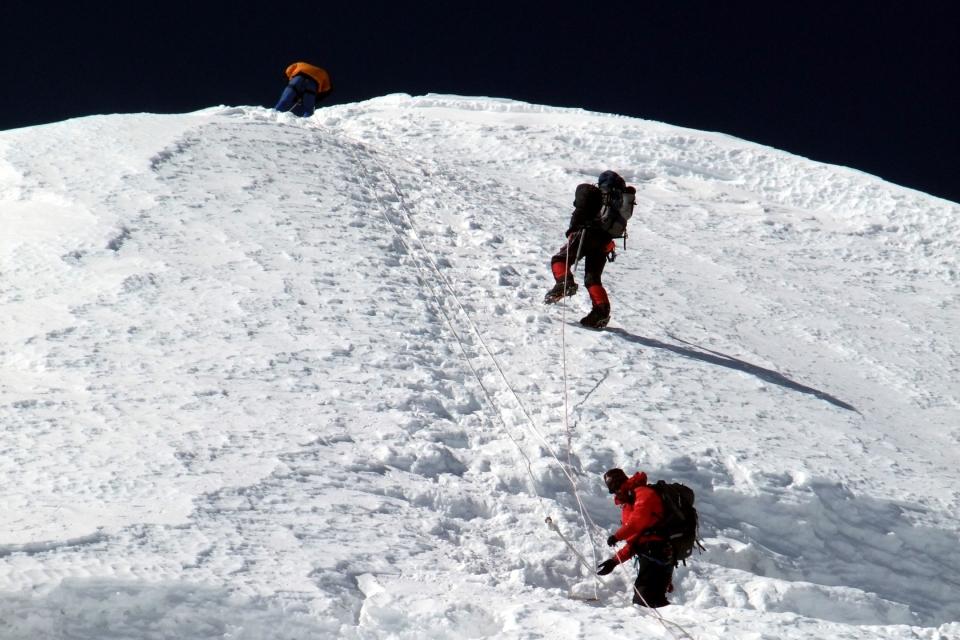
Mera Peak is often described as a "trekking peak" in the truest sense. The route from High Camp to the summit is primarily a glacier walk. While you will be roped up with your Best Heritage Tour guide for safety against crevasses, the gradient is generally gentle.
-
The Challenge: The "Mera Hump." The final 30-40 meters involve a steep snow slope (about 40-45 degrees) that may require the use of an ascender (jumar) on a fixed rope, depending on the season’s snow conditions.
-
The Reality: If you can walk for 6 hours in heavy boots, you can climb Mera.
Lobuche East: The Technical Introduction
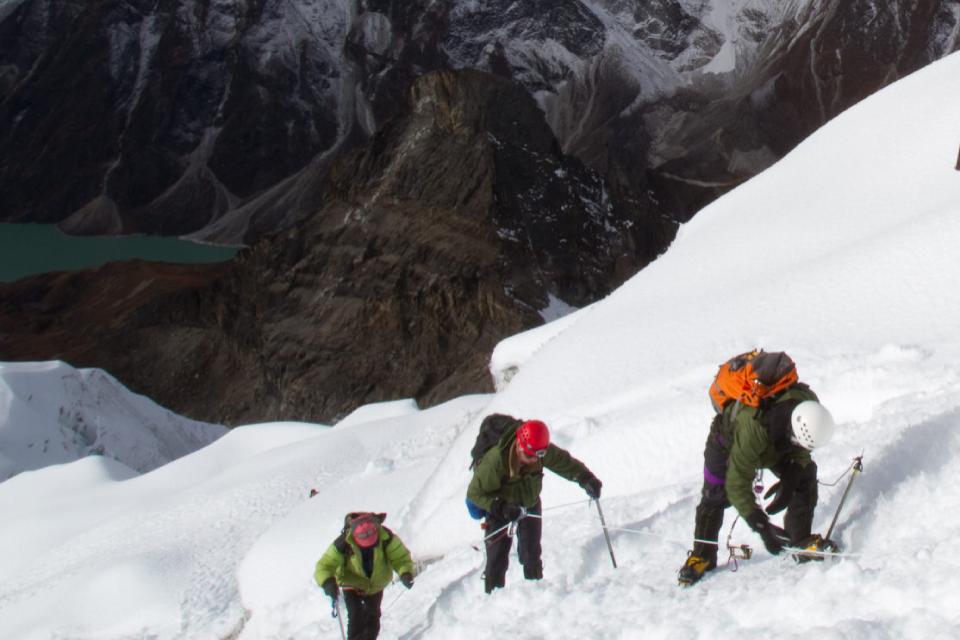
Lobuche East is a different beast entirely. It is widely considered more technical than both Mera and the famous Island Peak. The approach involves scrambling over rock slabs (often slippery with ice) before reaching the "Crampon Point."
-
The Challenge: The summit ridge. You will encounter steep sections of 45 to 55 degrees on snow and ice. You must be comfortable using a Jumar to ascend fixed lines and, more importantly, a Figure-8 or ATC to abseil (rappel) down.
-
The Reality: Lobuche East feels like "real" mountaineering. It requires better hand-eye coordination and comfort with exposure (heights).
The Altitude Factor: Is Higher Always Harder?
Mera Peak stands at 6,476m, making it nearly 350 meters taller than Lobuche East. In the thin air of the Himalayas, 350 meters is a massive difference.
At the summit of Mera Peak, you are breathing only about 45% of the oxygen available at sea level. This makes the summit day an grueling test of cardiovascular fitness. Even though the "climbing" is easier, the "breathing" is harder.
Lobuche East, while lower, sits in the heart of the Khumbu. Many climbers combine it with an Everest Base Camp trek, meaning they arrive at the base camp already well-acclimatized. However, the technical exertion on Lobuche can spike your heart rate just as quickly as the altitude on Mera.
Scenery and Summit Views: What’s the Reward?
Both peaks offer what we consider the best "bang for your buck" views in Nepal, but the vistas are distinct.
The Panorama of Five Giants (Mera Peak)
Because of its unique position east of the main Everest trail, Mera Peak offers a broader perspective. On a clear morning, you can see five of the world’s six highest mountains:
-
Mount Everest (8,848m)
-
Lhotse (8,516m)
-
Makalu (8,485m)
-
Cho Oyu (8,188m)
-
Kanchenjunga (8,586m) - visible in the far distance.
The Everest Immersion (Lobuche East)
Lobuche East is essentially a balcony overlooking the Khumbu Glacier. You aren't just looking at the mountains; you are among them.
-
You get an incredible profile view of the Everest-Lhotse-Nuptse wall.
-
The view of Ama Dablam from Lobuche is often cited as the most beautiful mountain sight in Nepal.
-
You can look straight down onto the Khumbu Icefall and see the colorful tents of Everest Base Camp during the spring climbing season.
Itinerary and Accessibility
The Remote Hinku Valley (Mera)
The trek to Mera Peak takes you through the Hinku Valley. This area is less developed than the main Everest trail. You’ll walk through lush rhododendron forests and high alpine meadows without the crowds of Namche Bazaar. It is a "wilder" experience.
The Iconic Khumbu Trail (Lobuche)
The journey to Lobuche East follows the legendary Everest Base Camp trail. You get the cultural richness of the Sherpa capital (Namche), the spiritual energy of Tengboche Monastery, and the comfort of some of the best teahouses in the world.
Training and Preparation: Which is for You?
Prepare for Mera Peak if:
-
You are an avid hiker or marathon runner with high stamina.
-
You want to break the 6,000m barrier with minimal technical fuss.
-
You prefer quiet, remote trails over busy tourist routes.
-
Training Tip: Focus on "Zone 2" cardio. Long, slow weighted hikes (15kg+ pack) are your best friend.
Prepare for Lobuche East if:
-
You have goals of climbing 7,000m or 8,000m peaks (like Ama Dablam or Everest) in the future.
-
You want to learn or practice technical rope skills.
-
You enjoy rock scrambling and "hands-on" movement.
-
Training Tip: Incorporate stair climbing and basic strength training (squats/lunges) to handle the steep summit pitch.
The Best Heritage Tour Advantage
Climbing in Nepal is an exercise in trust. When you choose Best Heritage Tour, you aren't just hiring a guide; you are joining a family of Himalayan experts.
-
1:2 Guide-to-Climber Ratio: On summit day, safety is paramount. We ensure our Sherpa guides are never overstretched.
-
Fixed Rope Mastery: Our team handles the heavy lifting of fixing lines on Lobuche East, ensuring you have a secure "handrail" to the top.
-
High-Quality Gear: From North Face VE-25 tents at High Camp to tested oxygen systems (for emergencies), we don't cut corners.
-
Acclimatization-First Philosophy: We build "buffer days" into every itinerary. We’d rather you summit a day late than not at all.
Conclusion: So, Which is Easier?
The answer depends on how you define "easy."
Mera Peak is technically easier. If you are worried about ropes, carabiners, and vertical ice, Mera is the logical choice. It is a long, slow, magnificent slog to the sky.
Lobuche East is physically "easier" in terms of duration and altitude, but it demands more focus and skill. If you find walking on a flat glacier for 6 hours boring and would rather be engaged with your gear and the rock, Lobuche will feel more natural to you.
Regardless of your choice, both peaks represent a monumental achievement. Standing at 6,000 meters, looking out over the roof of the world, is an experience that stays with you forever.
Ready to touch the sky?
Let Best Heritage Tour take you there. Whether you want the panoramic heights of Mera or the technical thrill of Lobuche East, our expert team is ready to organize your 2026 expedition.
Phone / WhatsApp / Viber: +977-9851149197 / +977-9810043046
Email: info@bestheritagetour.com / bestheritagetour@gmail.com
Website: www.bestheritagetour.com
Office: Thamel Marg, Kathmandu, Nepal
Author: Best Heritage Tour
Date: 8th April, 2026