
At Best Heritage Tour, we believe that you haven’t truly experienced Nepal until you’ve tasted it. While our majestic peaks and ancient temples often take center stage, the heartbeat of Kathmandu is found in its steaming pots of momo, the rhythmic "clink" of chai glasses, and the complex aromas of spices wafting through the narrow alleys of Asan and Indra Chowk.
If you are wondering how to eat like a local in Kathmandu as a foreigner, you’ve come to the right place. We aren't just tour operators; we are lifelong residents of this vibrant city. We know where the secret kitchens are, which street vendors have been serving the same recipe for forty years, and how to navigate a traditional Newari feast without looking like a total novice.
Pack your appetite - this is your ultimate guide to feasting like a local in the City of Temples.
Beyond the Menu: The Philosophy of Eating in Kathmandu
To feast like a local in Kathmandu, you must first understand that food here is more than just sustenance; it is a ritual, a social connector, and a source of immense pride. In the West, dining is often a private affair. In Kathmandu, it is communal.
The "Bhatti" Culture
Forget five-star dining for a moment. To eat like we do, you need to find a Bhatti. These are small, often dim, local eateries tucked away in the backstreets. They don't have fancy signage or laminated menus, but they do have the freshest choyila (spiced grilled meat) and the coldest local brew.
Timing is Everything
Locals don’t follow the standard "Breakfast-Lunch-Dinner" Western schedule.
-
Early Morning: A light tea and perhaps a biscuit or sel roti.
-
Late Morning (10:00 AM): This is the main event - Dal Bhat.
-
Mid-Afternoon (2:00 PM - 4:00 PM): Khaja (Snack time). This is when we feast on momos, noodles, or Newari platters.
-
Evening: A lighter dinner, often another round of Dal Bhat or rotis.
The Golden Rule: Master the Dal Bhat Power
If there is one phrase every trekker and traveler knows, it’s "Dal Bhat Power, 24 Hour." At Best Heritage Tour, we often tell our guests: if you want to know where to eat like a local in Kathmandu, just follow the crowd at 10:30 AM.
What’s on the Plate?
A true local Dal Bhat isn't just rice and lentils. It is a symphony of flavors:
-
Bhat: Steamed rice (the foundation).
-
Dal: Lentil soup (the soul).
-
Tarkari: Seasonal vegetable curry.
-
Achar: A spicy, tangy pickle that cuts through the starch.
-
Saag: Stir-fried mustard greens.
Local Tip: When eating Dal Bhat, the "feast" is endless. In local joints, the servers will keep coming back to refill your rice and lentils until you are physically unable to eat more. It is the ultimate budget-friendly, high-energy meal for any traveler.
Food to Try in Kathmandu that Locals Love & Eat
If you want to move beyond the tourist-friendly butter chicken and pizza, here are the authentic things to try in Kathmandu that locals eat and love:
A. The Legendary Momo
You cannot visit Kathmandu and not eat your weight in Momos. While you can find them in Thamel or small shops in Patan for the most authentic experience.
-
The Filling: Buff (water buffalo) is the local favorite, followed by chicken and veg.
-
The Jhol: Many locals prefer Jhol Momo, where the dumplings are submerged in a spicy, sesame-based cold broth.
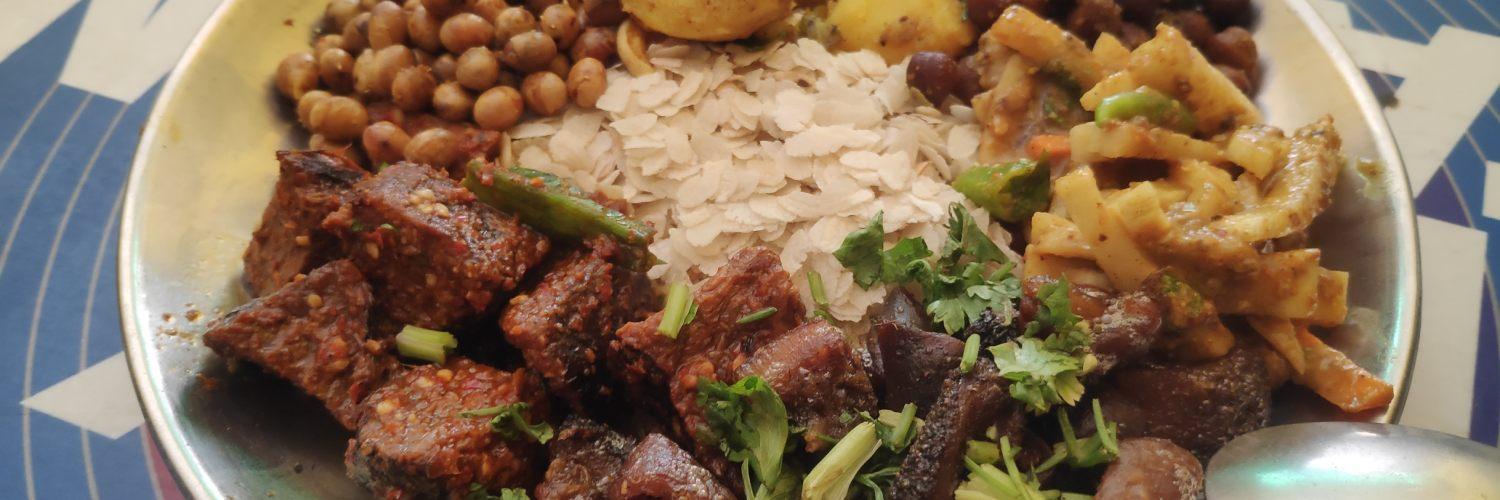
B. Newari Samay Baji
The Newars are the indigenous inhabitants of the Kathmandu Valley, and their cuisine is legendary. A Samay Baji set is a ritual feast on a plate. It includes:
-
Baji: Beaten rice.
-
Choyila: Spiced, grilled buff meat.
-
Bara: A savory lentil pancake.
-
Aloo Tama: A sour and pungent soup made of bamboo shoots and potatoes.
C. Sel Roti and Milk Tea
For a local breakfast, skip the pancakes. Find a street-side stall frying Sel Roti - a ring-shaped, sweet rice bread that is crispy on the outside and soft on the inside. Pair it with a glass of piping hot, sugary milk tea (Chiya), and you’ve officially started your day like a Kathmandu native.
D. Chatpate and Pani Puri
This is the ultimate street food experience. You’ll see locals huddled around small carts in the evenings. Chatpate is a spicy, sour mix of puffed rice, noodles, chickpeas, and fresh lime. It’s an explosion of flavor that defines the Kathmandu street scene.
Where to Eat Like a Local in Kathmandu: The Neighborhood Guide
Navigating the city's food scene can be overwhelming. Here is where we, at Best Heritage Tour, take our friends when they want the "real" stuff:
Indra Chowk & Asan Tole
This is the heart of old Kathmandu. Between the vegetable markets and spice stalls, you will find tiny holes-in-the-wall serving the best Lassi in the city. Look for the crowd standing near the corner of the square - that’s where the freshest, creamiest curd is served.
Kirtipur
For the most authentic Newari feast, take a short drive to Kirtipur. The hill-top town offers "Lahana," a community-run restaurant where you sit on straw mats and eat traditional dishes while overlooking the valley.
Patan (Lalitpur)
The backstreets around Patan Durbar Square are home to "Honacha," a legendary eatery that has been serving Newari snacks for decades. It’s rustic, it’s crowded, and it’s delicious.
Practical Tips for the Foreigner Feaster
We want you to enjoy your culinary journey without the dreaded "Delhi Belly" (or in this case, "Kathmandu Cramps"). Here is how to eat safely and respectfully:
-
The Right Hand Only: Traditionally, Nepalese people eat with their hands. If you choose to join in, always use your right hand. The left hand is considered "unclean" for eating.
-
Water Wisdom: Never drink tap water. Even locals often boil or filter their water. Stick to bottled water or "Jar water" provided by reputable restaurants.
-
Follow the Steam: When eating street food, choose vendors where the food is being cooked fresh in front of you. High turnover and high heat are your best friends.
-
Spiciness Check: Nepalese "medium" is often "extra hot" for foreigners. Don’t be afraid to ask for "Piro kam garnu" (Make it less spicy).
The Cultural Etiquette of the Feast
As a guest in our country, showing respect for food traditions goes a long way.
-
Jutho: Avoid touching your water bottle to your lips if you are sharing it. Don't touch someone else's food with your used spoon or hand. This concept of "Jutho" is very important in Nepalese households.
-
Gratitude: A simple "Dhanyabaad" (Thank you) to the cook or server is always appreciated.
-
Finish Your Plate: Leaving a lot of rice on your plate can be seen as wasteful. If you’re full, it’s okay, but try to take only what you can eat.
Why Local Food is Essential for Your Journey
Eating like a local isn't just about the calories; it's about the connection. When you sit on a small wooden bench, rubbing shoulders with a local shopkeeper while sharing a plate of spicy Aloo Dum, the barriers of language and culture melt away.
At Best Heritage Tour, we don't just want to show you the monuments; we want you to feel the pulse of the city. That pulse is found in the sizzle of the frying pan and the steam of the momo steamer.
Conclusion
Learning as a foreigner, how to eat like a local in Kathmandu is a journey of the senses. From the first sip of Himalayan tea to the final bite of a spicy Newari feast, every flavor tells a story of our heritage, our mountains, and our hospitality. Kathmandu is a city that feeds the soul - and the stomach - in equal measure.
We hope this guide empowers you to step outside the tourist bubbles of Thamel and explore the authentic, delicious, and vibrant world of Nepalese cuisine. Whether you are fueling up for an Everest Base Camp trek or winding down after a tour of the Durbar Squares, remember: eat hearty, eat local, and eat with an open heart.
Ready to Explore the Real Nepal?
If you want a guided culinary tour or a heritage walk that takes you to these hidden local gems, Best Heritage Tour is here to be your bridge to the authentic Kathmandu. We specialize in creating memories that go beyond the guidebook.
Phone / WhatsApp / Viber: +977-9851149197 / +977-9810043046
Email: info@bestheritagetour.com / bestheritagetour@gmail.com
Website: www.bestheritagetour.com
Office: Thamel Marg, Kathmandu, Nepal
Author: Best Heritage Tour
Date: 8th May, 2026