Deep in the heart of the Marsyangdi River valley, where the rugged cliffs of the Annapurna Circuit meet the misty subtropical jungles, lies a village called Chamje (often spelled Chamche). While many trekkers pass through this rocky outpost on their way to the higher altitudes of Manang, those in the know recognize Chamje for a far more visceral and ancient reason. It is one of the premier destinations in the world for Mad Honey Hunting.
At Best Heritage Tour, we don’t just see this as a tourist activity; it is a sacred, high-stakes ritual that has defined the Gurung and Magar indigenous communities for centuries. In this comprehensive guide, we dive into everything you need to know about Chamje, the giant Himalayan honeybee (Apis laboriosa), and why a Mad Honey hunting tour is the ultimate bucket-list experience for travelers, vloggers, and adventure seekers alike.
What is Mad Honey? The Science and the Myth
Before we trek into the cliffs of Chamje, it’s essential to understand what makes this honey "mad." Unlike the golden nectar found on supermarket shelves, Himalayan Mad Honey (known locally as Pagal Maha) is reddish in hue and possesses potent psychoactive and medicinal properties.
The Role of the Rhododendron
The secret lies in the diet of the bees. In the spring, the hills surrounding Chamje are carpeted in the vibrant blooms of Rhododendron (Lali Gurans), Nepal’s national flower. Certain species of rhododendron contain grayanotoxins. When the giant bees forage on these specific nectar sources, the toxin is concentrated into the honey.
The Effects: Medicinal and Mind-Altering
For the local people of Chamje, Mad Honey is a cherished medicine. In small, controlled doses, it is used to treat:
-
Hypertension (High Blood Pressure)
-
Joint pain and arthritis
-
Persistent coughs and digestive issues
However, for the uninitiated, "madness" is a literal description. A few tablespoons too many can lead to a state of drunkenness, characterized by a tingling sensation, dizziness, mild hallucinations, and a deep, heavy relaxation. In the international market, this "liquid gold" can fetch up to $900 per kilogram, making it one of the most expensive and sought-after natural products on Earth.
Why Chamje? The Epicenter of Honey Hunting
Nepal has several honey hunting sites, but Chamje holds a special status for several reasons:
-
Ideal Geography: The cliffs here are steep, southwest-facing, and located at the perfect altitude (around 1,400m to 2,500m) for the Apis laboriosa to build their massive, semi-circular combs.
-
Authentic Tradition: Unlike some commercialized spots, Chamje remains a bastion of the traditional Gurung lifestyle. The hunters here use the same techniques passed down through ten generations.
-
Accessibility for Vloggers: Chamje is easily accessible via the Besisahar-Chame road. For vloggers and documentary filmmakers, this means you can transport heavy camera gear and drones to the site without the weeks of trekking required for more remote regions like Upper Mustang or Manaslu.
-
The Landscape: Nestled beside the roaring Marsyangdi River and framed by the towering peaks of Annapurna II and Lamjung Himal, the visual backdrop of a hunt in Chamje is unparalleled.
The Ritual: More Than Just a Climb
At Best Heritage Tour, we emphasize that honey hunting is a spiritual undertaking. It is a dance between man, nature, and the "Cliff Gods."
The Sacred Offering
A hunt never begins without a ceremony. A local shaman or community elder chooses an auspicious date - traditionally a Tuesday. Before any hunter touches a rope, a small sacrifice (often a chicken or sheep) and offerings of rice and flowers are made to appease the forest spirits. This ensures the safety of the climbers and the continued prosperity of the bee colonies.
Traditional Gear: No Harnesses, No Safety Nets
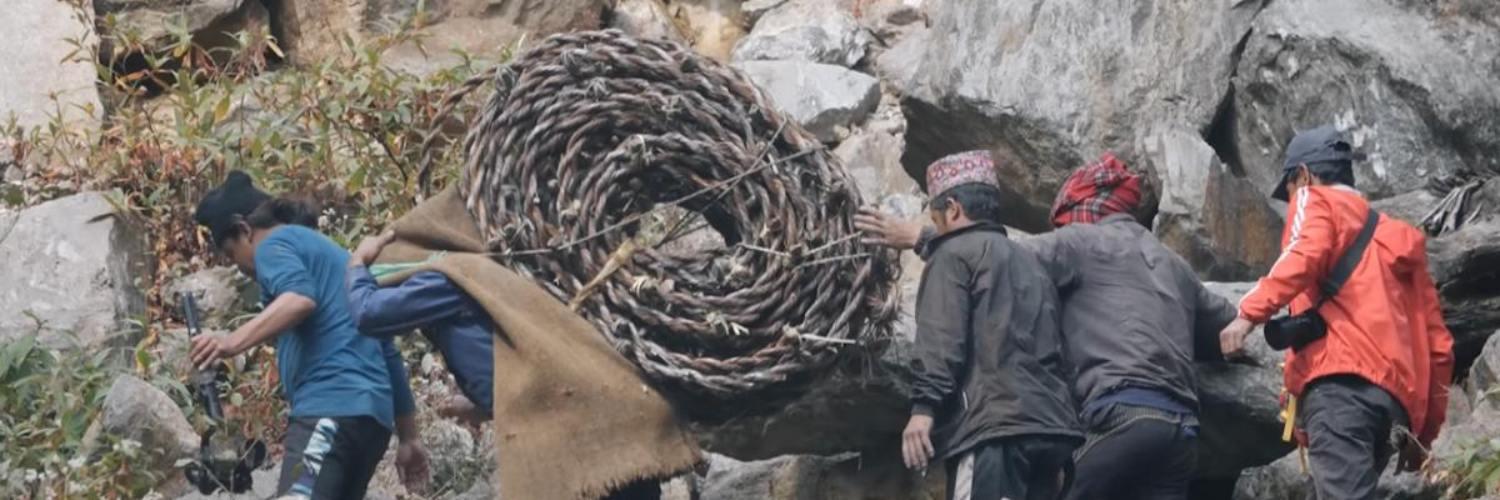
Witnessing a hunt in Chamje is a masterclass in ancient engineering. The equipment is entirely handcrafted:
-
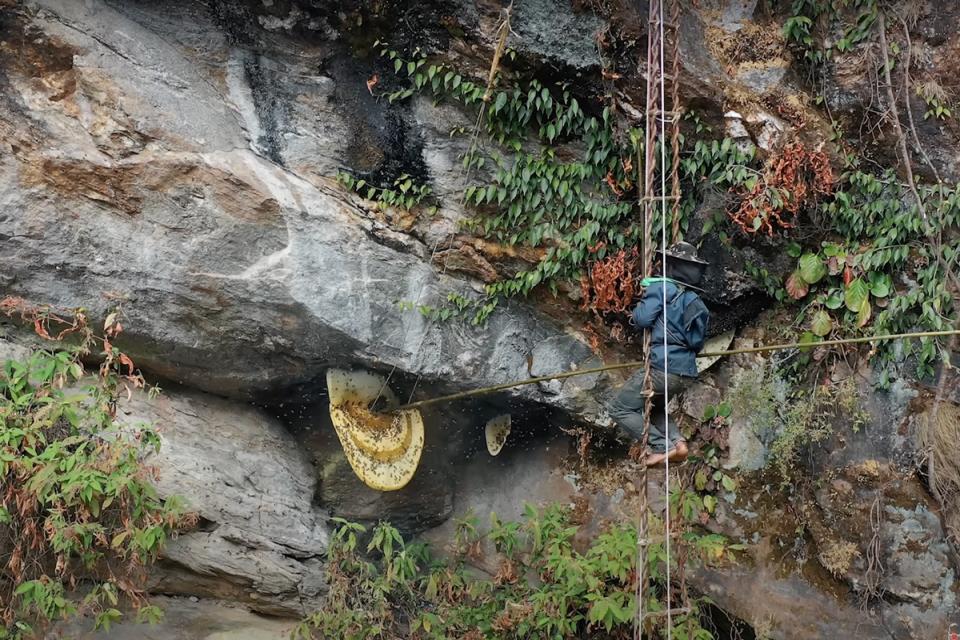
Prang (Bamboo Ladders): Hand-woven from local bamboo and hemp fibers, some stretching over 200 feet.
-
Tango (The Bamboo Pole): A long, sturdy pole with a sickle attached to the end to slice the honeycombs.
-
Tokari (The Basket): A bamboo basket lowered by a rope to catch the falling pieces of honeycomb.
The Hunt: A Spectacle of Bravery
The actual process of harvesting is a heart-pounding experience to watch.
-
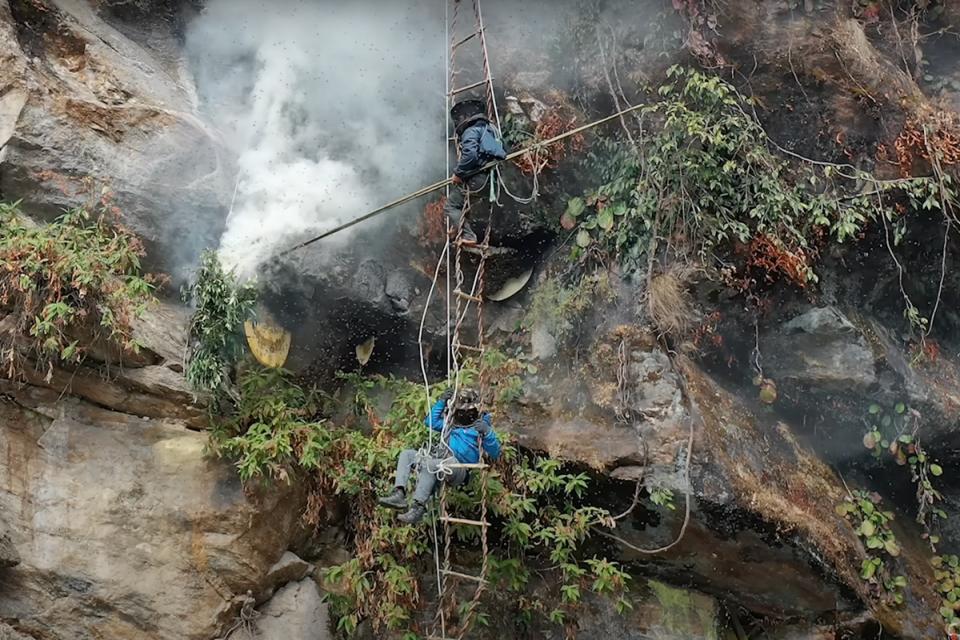
Smoking Out the Bees: At the base of the cliff, a team of villagers lights a fire using green leaves. The thick, acrid smoke rises toward the hives, disorienting the bees and forcing them to leave the combs temporarily.
-
The Descent: The lead hunter, known as the Amecchi, begins his descent. Hanging hundreds of feet above the rocky valley floor, he is supported only by the swaying bamboo ladder. He wears minimal protection - often just a thin mesh over his face - relying on his nerves of steel.
-
The Extraction: Balancing precariously, the hunter uses the tango to guide the basket under the hive while using the sickle to cut the comb. The air is thick with thousands of angry, giant bees, but the hunter remains calm, moving with a rhythm that feels almost meditative.
-
The Distribution: Once the baskets are lowered, the village erupts in celebration. The honey is shared among the community, used for rituals, and a portion is set aside for guests and trade.
Planning Your Chamje Mad Honey Tour
If you are planning to join us at Best Heritage Tour for this once-in-a-lifetime expedition, timing and preparation are key.
The Best Time to Visit
Honey hunting in Chamje happens twice a year:
-
Spring (Late April to May): This is the primary season for Mad Honey. The rhododendrons are in full bloom, and the honey is at its most potent and "mad." The weather is lush and green, though you may encounter a few leeches on the trail.
-
Autumn (October to November): This is the best season for photography and trekking. The skies are crystal clear, offering sharp views of the Annapurna range. While the honey is less psychoactive during this time, the harvest is still a magnificent cultural event.
Fitness and Requirements
While the trek to Chamje itself is moderate, reaching the actual cliff sites involves hiking through steep, uneven jungle terrain. A basic level of physical fitness is required. For those who wish to actually "try" the honey, we advise doing so only under the strict supervision of our guides and the local villagers to ensure safety.
What to Pack for Your Trip
-
Neutral Clothing: Avoid bright colors like yellow or red, which can attract or agitate the bees.
-
Protective Gear: A lightweight bee veil (though we provide these for our guests).
-
Camera Gear: Wide-angle lenses for the landscape and a powerful zoom to capture the details of the hunter on the cliff.
-
Sturdy Hiking Boots: The trails around Chamje can be slippery, especially near the waterfalls.
Conclusion
A trip to Chamje for a Mad Honey hunting tour is more than just an adventure; it is a journey back in time. It is a chance to see the raw power of nature and the incredible resilience of the human spirit. Whether you are a vlogger looking for that "viral" shot of a hunter silhouetted against the Himalayan sky, or a traveler seeking a deeper connection to the earth, Chamje will leave you breathless.
The sound of the roaring river, the smell of woodsmoke and wild nectar, and the sight of a lone man hanging between heaven and earth - this is the soul of Nepal.
Book Your Heritage Adventure with Us
Are you ready to witness the "Liquid Gold" of the Himalayas? Best Heritage Tour is your gateway to the most authentic and safe honey hunting experiences in Nepal.
Phone / WhatsApp / Viber: +977-9851149197 / +977-9810043046
Email: info@bestheritagetour.com / bestheritagetour@gmail.com
Website: www.bestheritagetour.com
Office: Thamel Marg, Kathmandu, Nepal
Author: Best Heritage Tour
Date: 29th March, 2026