The air in the foothills of the Annapurna range is thin, crisp, and heavy with the scent of blooming rhododendrons. But as you venture deeper into the remote Lamjung or Gorkha districts, the serene trekking trails give way to something far more primal. You hear it before you see it: a low, rhythmic hum that vibrates through your chest.
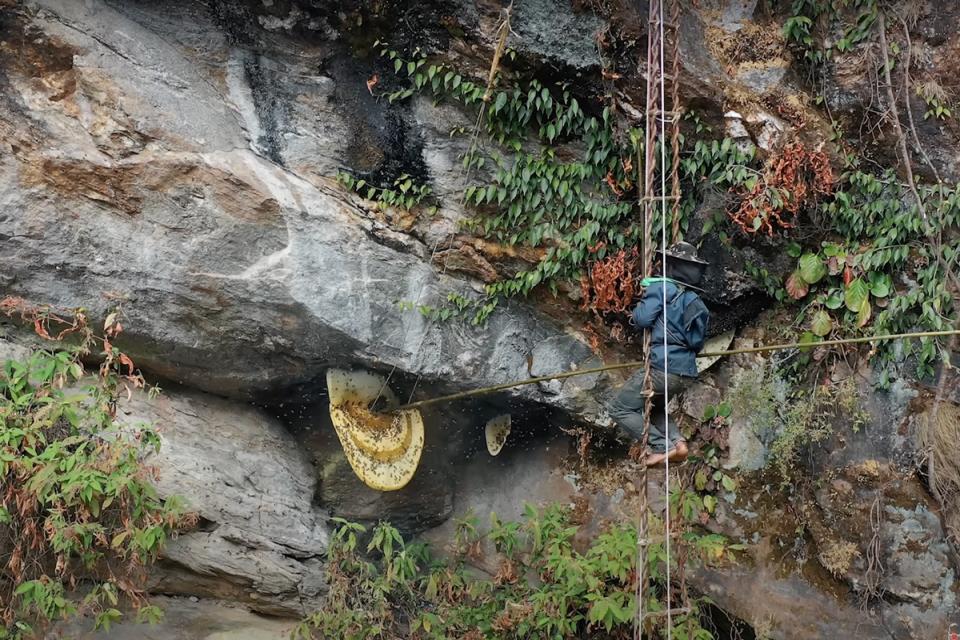
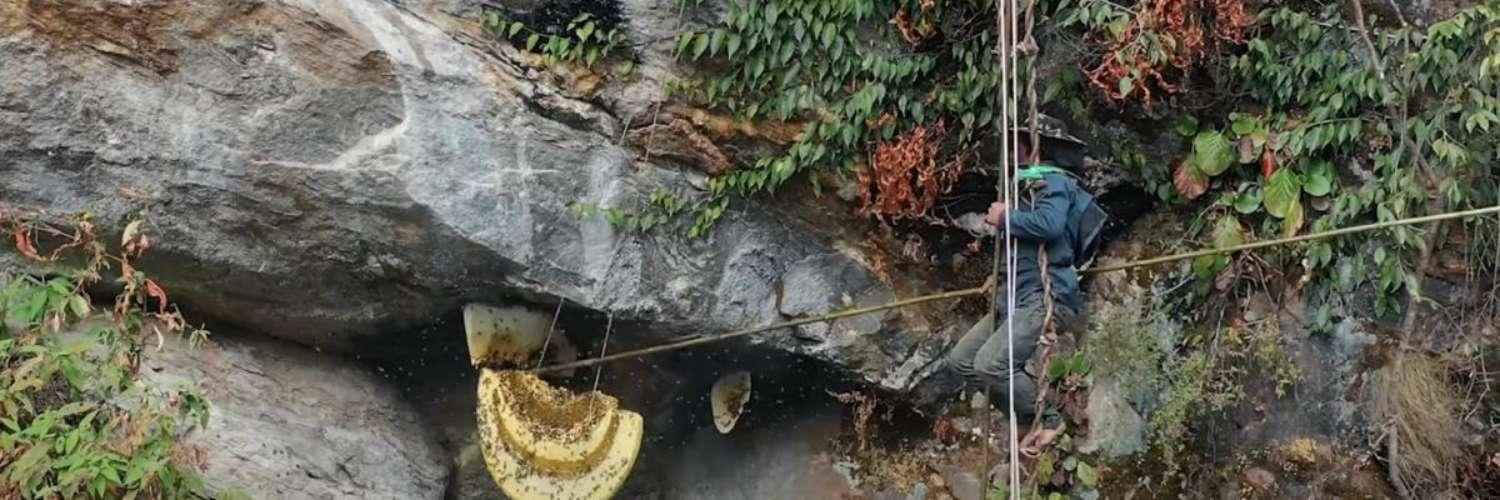
High above, suspended on hand-woven fiber ladders against sheer, vertical cliffs, are men who seem to defy gravity. These are the Mad Honey Hunters.
For trekkers, vloggers, and travelers seeking the "authentic" Nepal, the story of Mad Honey is the ultimate intersection of adventure, biology, and ancient culture. At Best Heritage Tour, we believe that understanding the people behind the honey is just as important as the journey to find it.
What is Mad Honey? (The Science Behind the Sting)
Before we talk about the hunters, we must talk about the "Madness." To the local Gurung and Kulung people, it is known as Phaos. To the scientific community, it is honey infused with grayanotoxins.
This isn't your average supermarket clover honey. This potent nectar is produced by the Apis dorsata laboriosa - the Himalayan giant honeybee. These are the largest honeybees in the world, measuring up to 3 cm in length.
The Rhododendron Connection
The "madness" comes from the bees' diet. In the high altitudes of the Himalayas (between 2,500 and 4,000 meters), the giant bees forage on specific species of rhododendron - specifically Rhododendron luteum and Rhododendron ponticum. These flowers contain grayanotoxin. When the bees process this nectar, the toxin becomes concentrated in the honey.
The result? A reddish, viscous liquid that, when consumed in small amounts, offers medicinal benefits. In larger amounts, it becomes a powerful hallucinogen. In excessive amounts, it can be life-threatening.
The Guardians of the Tradition: Who are the Honey Hunters?
The honey hunters are primarily members of the Gurung and Kulung ethnic groups. For these communities, honey hunting is not a hobby or a commercial enterprise; it is a sacred, communal ritual that has remained largely unchanged for thousands of years.
A Spiritual Permission Slip
A honey hunter doesn't just climb a cliff whenever they feel like it. The harvest is dictated by the lunar calendar and deep spiritual beliefs. Before a single foot touches a ladder, a Pooja (ceremony) is performed.
The hunters offer food, flowers, and prayers to the forest spirits and the cliff gods. They seek permission to take the honey and protection from the bees. It is a humble acknowledgment that in these mountains, humans are guests, and the bees are the masters.
The Role of the "Lead Hunter"
Every team has a leader - usually an elder who has inherited the skill from his father. This knowledge is passed down through oral tradition and hands-on apprenticeship. It involves:
-
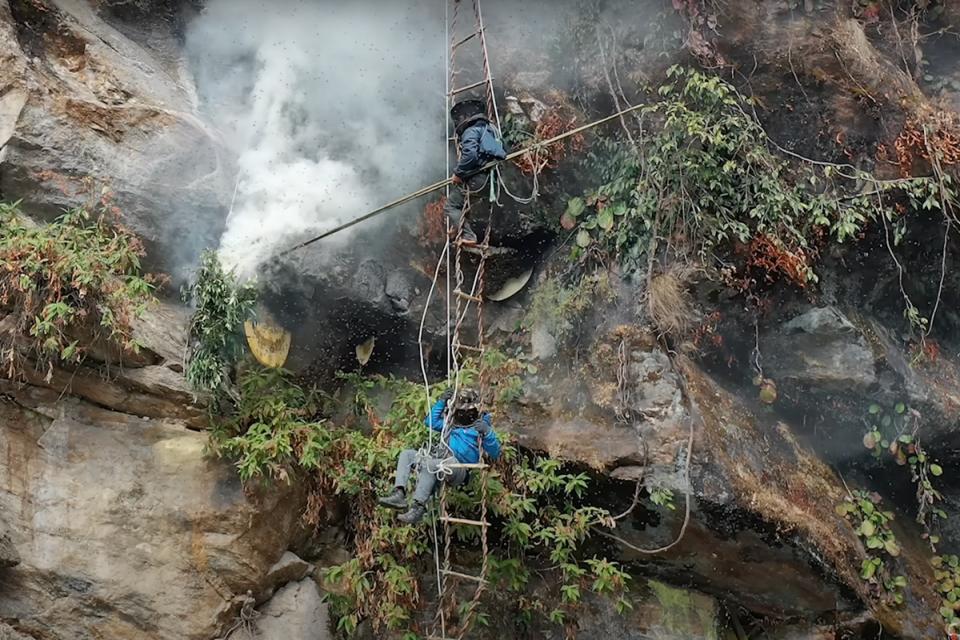
The Smoke-Maker: The person responsible for managing the smoldering grass that calms the bees.
-
The Ladder-Fixer: The guardian of the hemp ropes.
-
The Harvester: The brave soul who dangles hundreds of feet in the air with a bamboo pole.
The Death-Defying Harvest: How It’s Done
If you’re a trekker or a vlogger witnessing this for the first time, your heart will be in your throat. There are no carabiners, no modern climbing harnesses, and no safety nets.
1. The Bamboo Ladder (The Parang)
The hunters use ladders made of hand-twisted Himalayan bamboo and hemp rope. These ladders are anchored to trees at the top of the cliff and dangle over the edge. They are slippery, narrow, and swing violently in the mountain wind.
2. The Smoke Ceremony
At the base of the cliff, the team lights a fire using green wood and leaves to create thick, acrid smoke. This smoke rises toward the hives, confusing the giant bees and forcing them to leave the combs. However, these bees are aggressive. Even with the smoke, the hunters are often stung dozens, if not hundreds, of times.
3. The "Tango" on the Cliff
The lead hunter descends the ladder. Using two long bamboo poles (known as tango), he performs a terrifyingly delicate dance. One pole is used to slice the honeycomb, while the other guides a bamboo basket (the tokari) to catch the falling chunks of golden wax.
All of this happens while thousands of angry giant bees swarm around the hunter. It is a display of nerves that makes modern "extreme sports" look like child's play.
The Effects of Mad Honey: Why Seek the "Madness"?
Why do people risk their lives for this? The answer lies in the honey's unique properties. For the traveler, tasting Mad Honey is often a bucket-list item, but it must be approached with extreme caution.
Medicinal Uses in Local Culture
In small doses (usually a teaspoon), the honey is used by locals to:
-
Treat hypertension (high blood pressure).
-
Relieve joint pain and arthritis.
-
Boost the immune system and improve libido.
The Hallucinogenic Experience
In slightly larger doses, the grayanotoxins affect the central nervous system. Users report a feeling of "pleasant numbness," followed by a sense of euphoria, lightheadedness, and altered visual perceptions.
A Word of Caution from Best Heritage Tour: We always advise our travelers to never consume Mad Honey without the supervision of a local guide. "Honey poisoning" is real - it can lead to a drop in blood pressure, fainting, and heart palpitations. It is a powerful substance that demands respect.
Why Every Traveler Should Care: The Cultural Significance
For the vlogger or the documentary filmmaker, the Mad Honey hunters offer a visual spectacle. But for the true traveler, the story is about resilience and change.
This tradition is under threat. Modernization, the migration of youth to cities for work, and climate change are making the harvests rarer. The giant bees are sensitive to temperature changes; as the Himalayas warm, the bees move higher, making the already dangerous cliffs even more inaccessible.
When you visit these regions with Best Heritage Tour, you aren't just a spectator. Your presence supports the local economy, providing an alternative income that helps these communities preserve their traditions rather than abandoning them for factory work.
Frequently Asked Questions (FAQs)
Is Mad Honey legal?
In Nepal, it is perfectly legal and is sold in many local markets. However, international laws vary regarding its import due to the grayanotoxin content. Always check your home country's customs regulations.
How much does the Mad Honey cost?
On the international black market, Mad Honey can fetch up to $60-$100 per pound. Locally, it is much more affordable but still significantly more expensive than regular honey.
Can I try Mad Honey during Mad Honey hunting tour?
Yes, but start small! A tiny lick of the spoon is enough to feel the tingle on your tongue. Do not treat it like regular honey on toast.
Conclusion
The Mad Honey hunters of Nepal represent a bridge to our collective past. In a world where everything is automated and "safe," these men continue to dangle from ropes made of grass to harvest a substance that is both medicine and myth.
For the trekker, the reward isn't just the honey - it's the grueling hike, the mist-covered cliffs, and the privilege of watching a 3,000-year-old tradition survive in the modern age. It is a reminder that there are still secrets in the mountains, and there are still people brave enough to seek them.
Are you ready to witness the legend for yourself?
At Best Heritage Tour, we specialize in taking you beyond the postcard views. We connect you with the heartbeat of Nepal - the traditions, the people, and the stories that stay with you long after you’ve returned home.
Experience the Extraordinary with Best Heritage Tour. Contact us today
WhatsApp/Phone: +977-9851149197 / +977-9810043046
Email: info@bestheritagetour.com / bestheritagetour@gmail.com
Website: www.bestheritagetour.com
Office: Thamel Marg, Kathmandu, Nepal
Author: Best Heritage Tour
Date: 18th February, 2026