The Nepal Honey Hunting Tour is world-famous for the sheer adrenaline of watching a man dangle hundreds of feet down a sheer cliff. Yet, the true marvel of this ancient tradition lies not in the daring climb, but in the handful of simple, ingenious, and entirely handmade tools that make the harvest possible.
The Gurung and Magar honey hunters, who risk their lives for the medicinal "Mad Honey" from the Apislaboriosa giant cliff bee, use no modern safety harness or steel scaffolding. Their toolkit is a testament to ancestral engineering - each component is crafted from locally sourced materials, primarily bamboo and various natural fibers, and relies entirely on gravity, friction, and teamwork.
The preparation of these tools is a sacred rite, a demonstration of the community's intimate knowledge of the forest and the cliff face. At Best Heritage Tour (BHT), we emphasize that observing the equipment is as important as witnessing the hunt itself, as it unlocks the true depth of this unique cultural practice.
Here is a detailed, authentic guide to the traditional equipment used by the fearless honey hunters of Lamjung and Myagdi.
The Ascent System - Rope, Ladder, and Anchor
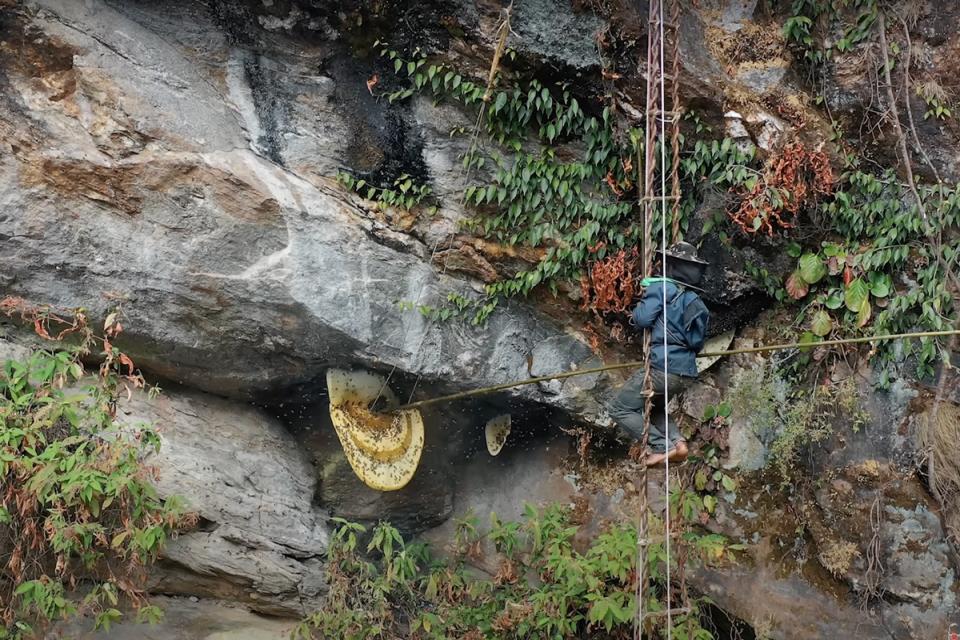
The most crucial element of the entire operation is the system used for vertical access - a heavy-duty assembly of ropes and a ladder that often stretches over 150 meters (500 feet) down the cliff face.
1. The Prang (The Rope Ladder)
The Prang is the star of the show, a towering, flexible ladder that defines the peril and the skill of the hunt.
-
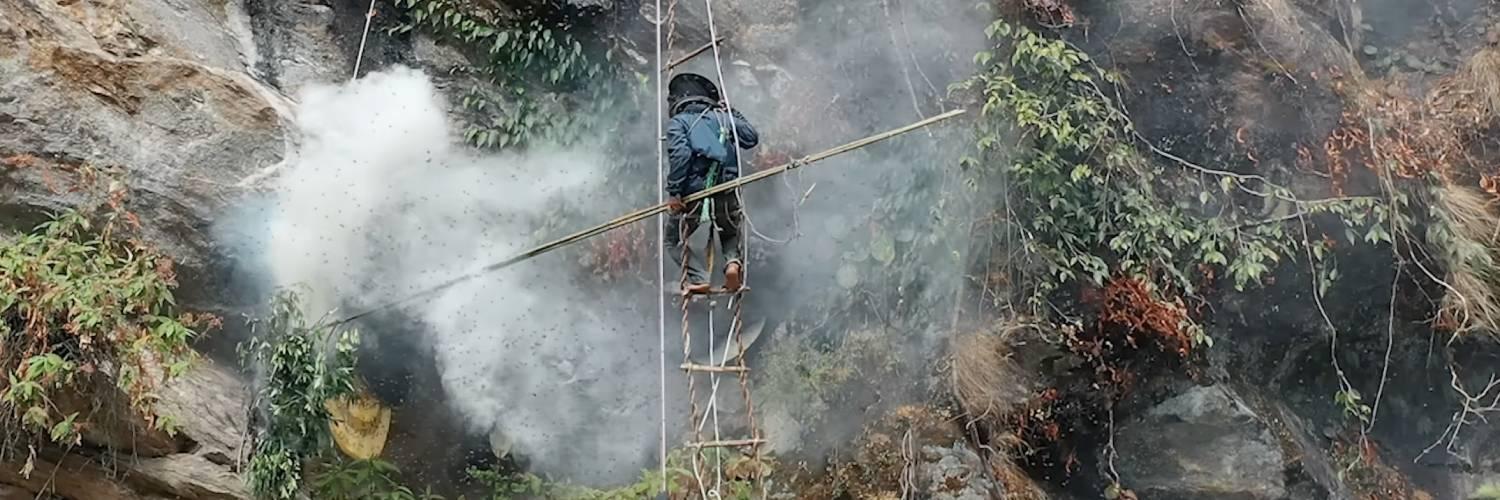
Construction: The ladder is painstakingly braided and tied from robust, locally available bamboo fibers or thick, durable jungle vines (like Allo fiber). It is not a rigid structure. The horizontal rungs are typically thick bamboo segments tightly lashed to the vertical ropes.
-
Engineering Principle: The flexibility is intentional; it allows the ladder to conform to the contours of the uneven rock face and absorb the hunter's weight and pendulum swings without snapping. Due to the difficulty and labor, a single Prang can take weeks to construct and is a communal resource maintained over years.
-
Placement: The Prang is anchored securely at the top of the cliff to a massive, ancient tree or a firmly wedged rock formation (Uab rope), often secured by a dedicated "anchor team" who manage the heavy initial throw and stabilization.
2. The Tuju and Whibe (Balancing and Manipulation Ropes)
Once the ladder is placed, the team uses a network of supporting ropes managed from the ground and the cliff top to ensure the hunter's safety and control.
-
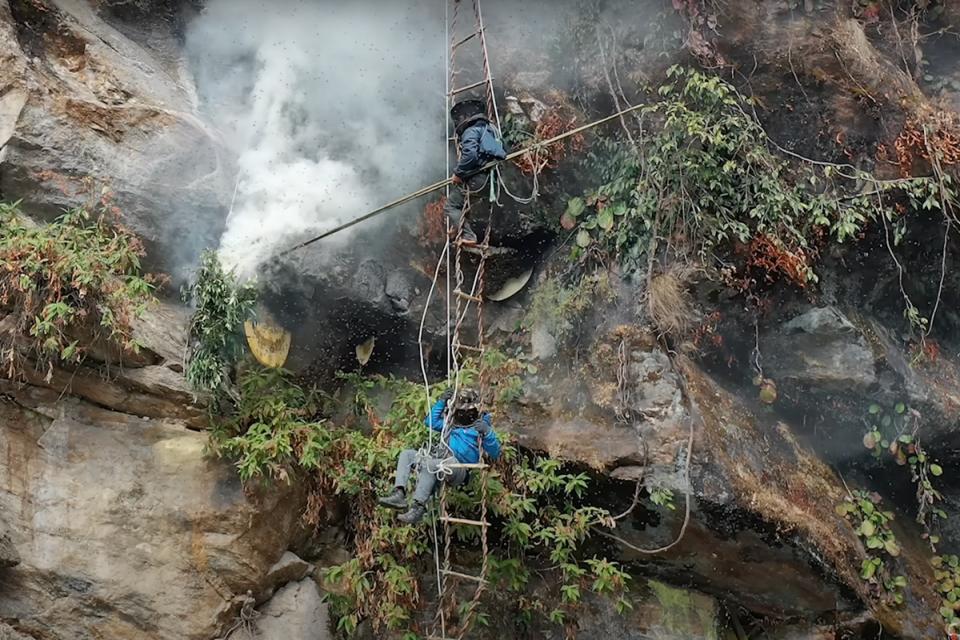
Tuju (The Balance Rope): This rope is attached to the ladder and anchored at various points on the ground below the cliff. It is managed by a team member whose job is to pull the Prang taut or push it away from the rock face, stabilizing the hunter against the wind and allowing him to reach the honeycomb precisely.
-
KohoChho (The Safety Rope): While often using the Prang itself for descent, a dedicated safety line, sometimes made of even stronger Pat fiber (jute), is used by the lead Amecchi (master hunter) to fasten himself to the ladder, providing a rudimentary safety tether.
The Harvesting Tools - Cut, Smoke, and Separation
Once the Amecchi is positioned directly in front of the giant hive (Apislaboriosa can build combs up to 2 meters wide), a specialized set of tools are deployed to manage the angry swarm and perform the surgical removal of the honey.
1. The KoiliChho (The Smoke System)
Before any physical contact, the bees must be pacified. This is achieved not with modern chemical sprays, but with a massive, targeted plume of smoke.
-
The Fire: A large fire is lit directly at the base of the cliff. The fuel is carefully selected green wood and leaves (often juniper or rhododendron) to produce a thick, acrid, non-toxic smoke rather than flame.
-
The Delivery: The smoke naturally rises toward the hive. It does not kill the bees, but disorients them, mimicking a forest fire and signaling them to temporarily vacate the hive and prepare to flee. The density and duration of the smoke are carefully managed by the ground crew to ensure effectiveness without harming the entire colony.
2. The Tango or Ghochma (The Cutting Pole)
The Tango is the hunter’s main weapon, an essential instrument of precision and force.
-
Construction: This is a long, straight bamboo pole, often seven to nine meters (23-30 feet) long to reach the hive from a safe distance on the ladder. At the end, a sharp, curved piece of wood or iron (a sickle-like blade) (Dabilo) is tightly affixed.
-
Function: The Tango is used with remarkable dexterity. Its primary function is to cut the massive honeycomb from the vertical rock face, detaching the honey-filled top portion (the precious Mad Honey) while leaving the lower, central brood portion intact to ensure the colony’s survival.
3. The Saaton (The Notched Stick)
-
Function: Used alongside the Tango, the Saaton is a long, notched bamboo stick used to guide or push the KoiliChho hook (a separate rope/hook system) into the desired section of the comb. It allows the hunter to precisely separate the honey-storing section from the brood (larvae) section, maintaining sustainability.
The Collection System - Baskets and Ropes
The honey, once cut, must be caught and lowered hundreds of feet to the ground without spilling or contaminating the precious golden liquid.
1. The Korko or Tokari (The Bamboo Basket)
-
Construction: The Tokari is a large, sturdy, round basket hand-woven from local bamboo. It is typically designed to hold 20 to 30 liters of comb.
-
Lining (Chhyakal or Khaal): Traditionally, the basket was lined with the skin of a sheep or goat (Chhyakal), which was flexible and contained leaks. Today, durable plastic sheeting is often used as a modern, hygienic replacement, but the principle remains the same: a non-porous lining to prevent the valuable honey from seeping through the woven bamboo.
-
Suspension: The Tokari is suspended by a long rope (Pechho) which is controlled by the team at the base of the cliff. The hunter guides the basket into position just below the cut using another long stick, the guiding stick, which is also manipulated from the base of the cliff using the Whibe rope for precision.
2. The Pechho (The Hauling Rope)
-
Function: This is the dedicated rope used to lower the filled Tokari and hoist the empty one back up. It must be exceptionally long and strong. The smooth, coordinated lowering and raising of the Pechho rope is a critical part of the teamwork, minimizing swinging and impact that could break the rope or injure the hunter.
Processing and Finishing Tools
The traditional equipment is also used for the immediate processing and preparation of the honey for transport.
1. The Chhora (The Filter)
-
Function: Once the comb reaches the ground, the community uses the Chhora - a filter usually made from finely woven bamboo cortex or thick cloth - to separate the honey from the beeswax and any large debris or dead bees, ensuring the purity of the harvested product.
2. The Donga (The Collecting Bowl)
-
Function: Traditionally, the collected beeswax was melted and poured into a wooden bowl (Donga) to cool and be shaped for later use in religious rituals, candles, or sealing. Today, aluminium pots may replace the wooden Donga but the purpose remains to conserve every part of the hive.
Conclusion: Ingenuity Rooted in Tradition
The traditional Honey Hunting Equipment in Nepal is a profound demonstration of indigenous engineering. Far from being primitive, these tools - the Prang, the Tango, and the Tokari - are perfectly adapted for the specific challenge of harvesting the Apislaboriosa hive, a task too difficult for modern equipment to replicate safely and sustainably.
The tools are not just instruments; they are vessels of cultural knowledge. Their preparation, their use, and their careful maintenance are central to the rituals of the Gurung and Magar communities.
By embarking on a honey hunting tour with Best Heritage Tour (BHT), you are not just witnessing an adventure; you are honoring a legacy of human ingenuity and a sustainable partnership between man and the wildest bee in the Himalayas.
Ready to witness the mastery of the traditional honey hunter and his ancestral tools? Contact BHT to plan your journey to the cliffs of Lamjung or Myagdi.
Phone / WhatsApp / Viber: +977-9851149197 / +977-9810043046
Email:info@bestheritagetour.com / bestheritagetour@gmail.com
Website:www.bestheritagetour.com
Office:Thamel Marg, Kathmandu, Nepal
Author: Best Heritage Tour
Date: 8th December, 2025