Travel Insurance for Trekking in Nepal
If you are sitting at home right now, looking at photos of the sun rising over Mount Everest or dreaming about crossing the high-altitude Thorong La Pass, we know exactly what is running through your mind. The sheer majesty of the Himalayas is intoxicating. But as a professional travel company - Best Heritage Tour, we must tell you the honest truth: the mountains are as unpredictable as they are beautiful.
Whether you are planning to tread the iconic path to Everest Base Camp, loop around the dramatic Annapurna Circuit, or explore the forbidden kingdoms of Upper Mustang, there is one piece of gear that is more important than your broken-in boots, down jacket, or trekking poles. That is your travel insurance policy.
In this comprehensive guide, we will break down exactly Why Travel Insurance is Must for Trekking in Nepal?, dissect the legal realities regarding trekking permits, explore the lifesaving logistics of helicopter evacuations, and show you exactly how to acquire proper coverage - even if you are already standing right here in our office in Kathmandu.
Is Travel Insurance Mandatory for Trekking in Nepal?
Let’s start with the question that lands in our company inbox almost daily: Is Travel Insurance Mandatory for Trekking in Nepal?
The short, direct answer is Yes. Without a valid, high-altitude travel insurance policy, it is next to impossible to issue your trekking permits.
The "No Insurance, No Permit, No Trek" Policy
The government of Nepal, alongside the Nepal Tourism Board (NTB) and the Trekking Agencies Association of Nepal (TAAN), enforces strict regulations for all international travelers. The days of simply buying a permit on a whim and heading into the high country without a safety net are completely gone.
Today, insurance verification is fully digitized and hard-linked into the permit issuance system. When we submit your paperwork to obtain your TIMS (Trekkers' Information Management System) Card, National Park Permits, or Restricted Area Permits (RAP), the system mandates a copy of your valid insurance policy.
Here is exactly how the rules apply across different routes:
|
Trekking Region / Permit Type |
Insurance Requirement Status |
Why it Matters for Your Permit |
|---|---|---|
|
Everest Base Camp / Khumbu Region |
Strictly Mandatory |
Cannot clear local municipality checkpoints or obtain regional entry cards without digital insurance upload. |
|
Annapurna Circuit & ABC (ACAP Permit) |
Strictly Mandatory |
ACAP checkpoints verify your policy details at entry gates like Besisahar or Nayapul. |
|
Restricted Areas (Manaslu, Upper Mustang, Dolpo) |
Compulsory / High Liability |
The Department of Immigration will not print Restricted Area Permits without verified emergency evacuation cover of at least $15,000 to $25,000 USD. |
|
Peak Climbing (Island Peak, Mera Peak, etc.) |
Compulsory & Specialized |
Requires specialized mountaineering extensions that cover both the climber and the local climbing guides/porters. |
Why Travel Insurance is Must for Trekking in Nepal? (The True Risks)
The Himalayas present environment variables that simply do not exist during standard holiday trips to European cities or tropical beaches. When you cross above 3,000 meters (around 9,840 feet), the human body enters a completely different physiological state.
The Threat of Acute Mountain Sickness (AMS)
Statistics show that nearly one in three trekkers crossing above 4,000 meters will experience some form of Acute Mountain Sickness (AMS). While a mild headache can often be managed with hydration, rest, and acclimatization, AMS can rapidly degenerate into life-threatening conditions:
-
HAPE (High Altitude Pulmonary Edema): Fluid buildup in your lungs.
-
HACE (High Altitude Cerebral Edema): Fluid buildup in your brain.
When HAPE or HACE strikes on the trail, you cannot simply call an ambulance. There are no roads connecting the high-altitude teahouses of Gorak Shep (5,164m) or Thorong Phedi (4,450m) to a modern medical facility. The only way down is by helicopter, and that comes with massive financial implications.
Rugged Terrain and Remote Geographies
Beyond altitude sickness, simple physical injuries can turn dangerous. A badly twisted ankle, a fractured wrist from a slip on glacial scree, or severe foodborne illnesses can make it physically impossible for you to walk. In remote stretches like the Manaslu Circuit or the wilderness of Dolpo, being unable to walk means you are completely stranded without emergency air transport.
How Does Travel Insurance Help for Helicopter Evacuation and Medical Emergencies?
When an emergency unfolds on the trail, the logistical machine behind a rescue springs into action. This is precisely how does travel insurance helps for Helicopter Evacuation and medical emergency situations.
The Real Cost of a Himalayan Rescue Flight
Chartering a private B3-class Eurocopter in Nepal to perform a high-altitude rescue is an incredibly complex aviation feat. Pilots are flying at the absolute limit of helicopter capabilities, dealing with thin air, shifting thermal currents, and tight mountain walls.
Because of these extreme risks, helicopter rescues in Nepal generally cost between $3,000 and $10,000+ USD per flight, depending heavily on your exact altitude and distance from Kathmandu or Lukla.
Low Altitude: Below 3,000m → $2,000 - $3,500 USD (e.g., Lower Annapurna)
Mid Altitude: 3,000m - 4,500m → $3,000 - $5,000 USD (e.g., Namche Bazaar)
High Altitude: 4,500m - 5,500m → $4,000 - $8,000 USD (e.g., Everest Base Camp)
Extreme Altitude: Above 5,500m → $6,000 - $15,000+ USD (e.g., High Passes / Peaks)
If you do not have travel insurance that explicitly covers emergency helicopter evacuation, helicopter operators will demand a cash or credit card deposit upfront before the rotors even turn in Kathmandu. Very few travelers carry $6,000 in cash on the trail or have credit limits that can instantly authorize massive foreign currency transfers from a remote mountainside.
How Best Heritage Tour Coordinates Your Rescue
When you trek with us, we act as your ground command center. If you fall seriously ill, here is exactly how your insurance saves your life:
-
On-Trail Assessment: Our wilderness-certified trekking guide monitors your vitals (including heart rate and blood oxygen saturation via pulse oximeter). If your condition deteriorates, the guide makes the operational call to evacuate.
-
Kathmandu Operations Contact: The guide contacts our central office in Kathmandu via mobile or satellite link.
-
Insurance Authorization: We immediately contact your insurance provider’s emergency 24/7 hotline, providing your policy number, exact GPS coordinates, and medical presentation.
-
Instant Dispatch (Zero Out-of-Pocket): Once the insurance provider provides a financial guarantee of payment, a helicopter is cleared for takeoff. You do not have to swipe a card or scramble for cash.
-
Hospital Handover: The helicopter flies you directly to a specialized facility in Kathmandu, where your medical insurance covers your admission, diagnostics, and treatment.
Can I Buy Travel Insurance in Nepal? And Where to Buy Travel Insurance in Kathmandu?
What happens if you have already boarded your flight, landed at Tribhuvan International Airport, and realized your policy from back home explicitly excludes adventure sports or caps your coverage at a mere 3,000 meters? Can you fix it?
Yes, you can absolutely buy Travel Insurance in Nepal, and Best Heritage Tour will help you through our trusted local partners.
Historically, travelers had to buy comprehensive packages from global insurance giants months before departing their home countries. However, the local insurance landscape has evolved significantly. Today, specialized domestic insurance products are designed specifically for foreign trekkers entering the Himalayas.
These local policies offer massive structural advantages:
-
Instant Activation: Policies can be issued directly in our Kathmandu office and become fully active within 24 hours.
-
Direct-to-Hospital Settlement: Local insurers have direct corporate ties with helicopter fleet operators and Kathmandu hospitals, completely bypassing long international verification delays.
-
Zero Deductibles on Scans: They are explicitly tailored to meet the exact minimum financial requirements mandated by the Nepal Tourism Board for permit clearance.
If you find yourself in Kathmandu without adequate coverage, do not panic. Simply walk into the Best Heritage Tour office, and our team will assist you in setting up a local policy that perfectly aligns with your chosen trekking itinerary.
How to Buy Travel Insurance in Nepal? (A Step-by-Step Guide)
If you are looking at how to buy travel insurance in Nepal, the process is straightforward when managed by a licensed agency. We have refined this into a seamless workflow to ensure you don't lose precious days of your holiday dealing with paperwork.
Step 1: Define Your Highest Trekking Altitude
Before buying any policy, you must know the exact peak elevation of your trek. A policy that covers you up to 4,000 meters is completely useless if you are crossing the Cho La Pass at 5,420 meters.
-
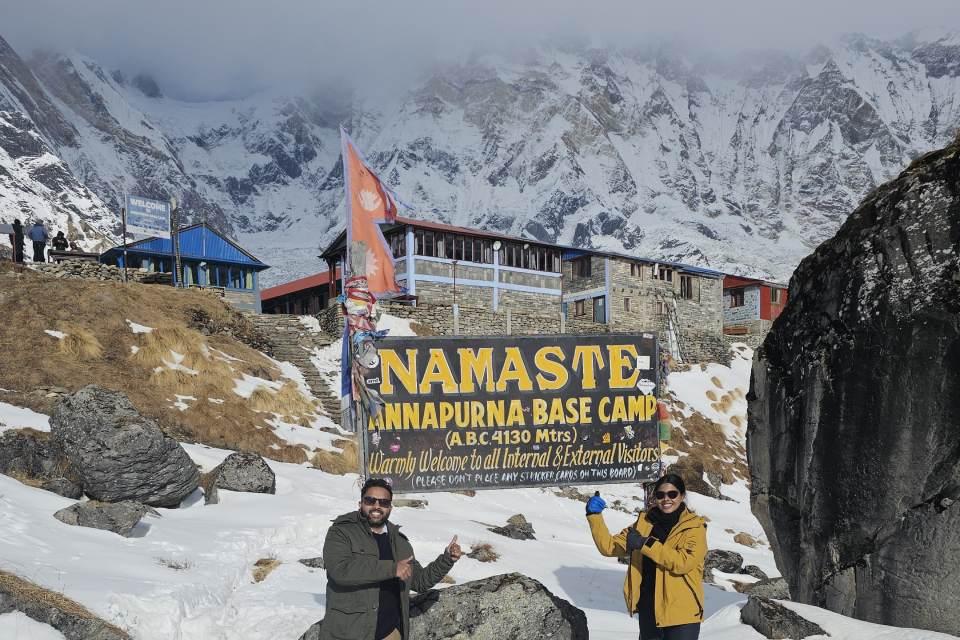
Annapurna Base Camp: Requires coverage up to 4,200m.
-
Everest Base Camp: Requires coverage up to 5,600m (to account for Kala Patthar).
-
Manaslu Circuit: Requires coverage up to 5,200m.
Step 2: Hand Over Your Logistics to Best Heritage Tour
Instead of navigating foreign payment gateways or confusing local insurance forms, you can let our team manage the entire process for you.
We will collect your essential details:
-
Your scanned passport copy.
-
Your exact trekking itinerary and dates.
-
Your emergency contact information.
Step 3: Policy Selection and Issuance
We sit down with you to select the precise tier of our trusted local partner's plan that matches your trek. We process the payment locally, and within hours, your digital insurance certificate is generated.
Step 4: Digital Permit Linking
Once the policy is issued, our backend team immediately attaches the policy number and insurance QR code to your official TIMS and National Park permit applications. This guarantees that your documents fly through government verification systems with absolutely zero friction.
What Must Travel Insurance Policy Cover for Trekking in Nepal? (The Non-Negotiable Checklist)
Whether you choose an international policy like World Nomads before leaving home or purchase a local plan with our help in Kathmandu, you must double-check the policy wording. Ensure that the fine print explicitly includes the following elements:
-
Explicit Altitude Limits: The text must state that coverage extends up to 6,000 meters (or your specific trek maximum). Look closely at the "Adventure Sports" or "Mountaineering" exclusion clauses.
-
Helicopter Evacuation Rider: General terms like "Medical Transportation" are often insufficient. It must explicitly mention Emergency Search, Rescue, and Air Ambulance/Helicopter Evacuation.
-
Direct Billing / Guarantee of Payment: Ensure the company can issue a fast-tracked financial guarantee to ground handlers in Kathmandu so you aren't forced to pay out-of-pocket during an emergency.
-
Trip Interruption and Lukla Delays: The weather in the mountains can cause sudden flight cancellations (especially on the sector into Lukla). A robust policy covers your accommodation adjustments and re-booking fees if weather alters your trek itinerary.
Conclusion
Trekking through the timeless heritage trails, ancient monasteries, and colossal peaks of Nepal is an experience that will reshape how you view the world. It is an adventure of a lifetime - but it must be approached with deep respect for the sheer power of the mountain environment.
Carrying proper travel insurance is not merely about checking a box for a government bureaucrat to hand over your permit. It is about protecting your health, providing complete peace of mind to your loved ones back home, and ensuring that if the unpredictable happens, a dedicated professional rescue team has your back.
At Best Heritage Tour, your safety on the trail is our absolute highest priority. From checking your oxygen levels every evening to ensuring your legal paperwork and safety nets are flawless, we handle the logistics so you can focus entirely on the magic of the Himalayas.
Get in Touch with Best Heritage Tour
Phone / WhatsApp / Viber: +977-9851149197 / +977-9810043046
Email: [email protected] / [email protected]
Website: www.bestheritagetour.com
Office: Thamel Marg, Kathmandu, Nepal